

Take The Patriot Seriously
Revisiting THE PATRIOT in an unpatriotic age

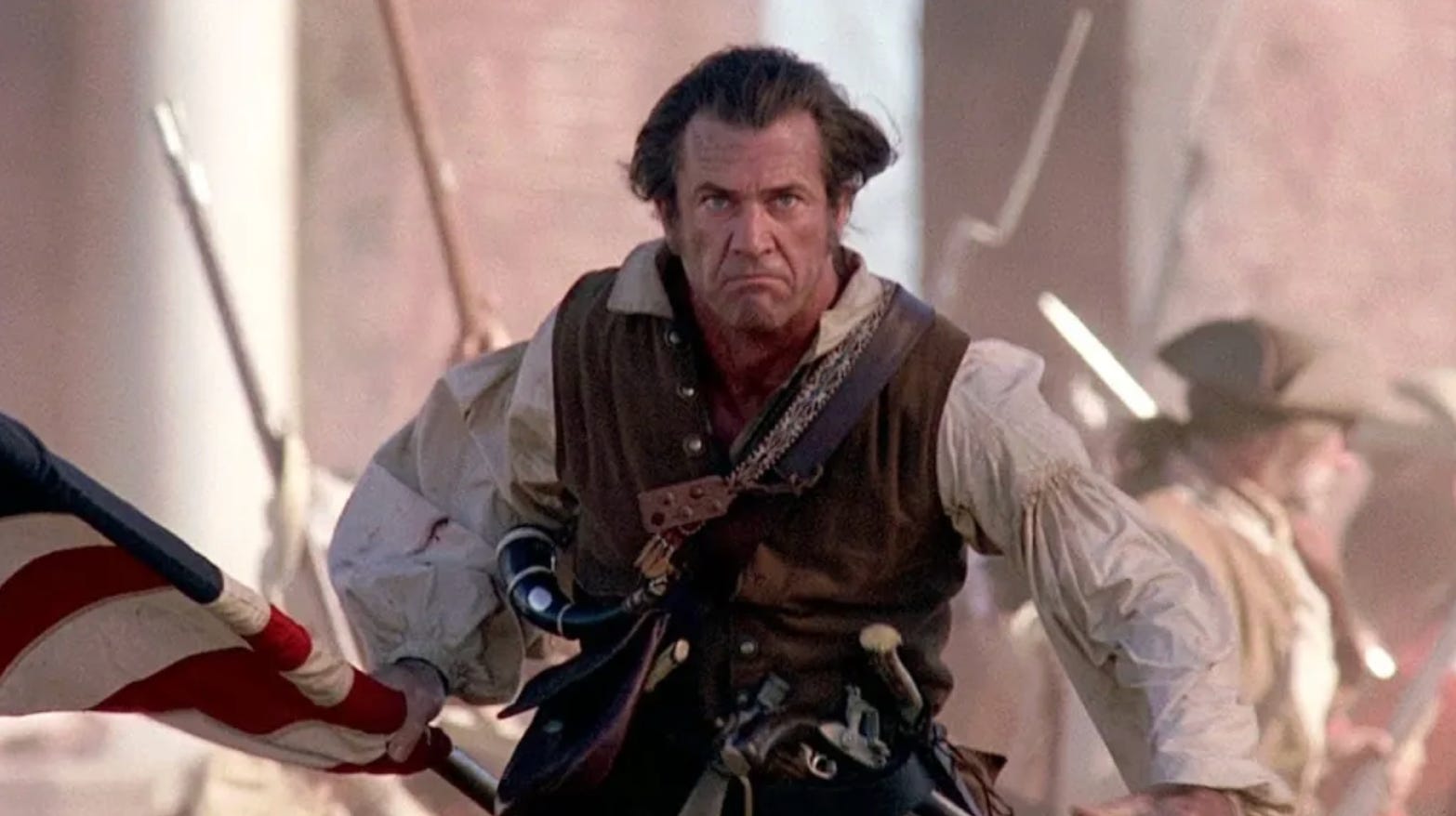
In the opening moments of The Patriot, Mel Gibson—I mean, Benjamin Martin—has just finished his latest attempt at building a rocking chair.
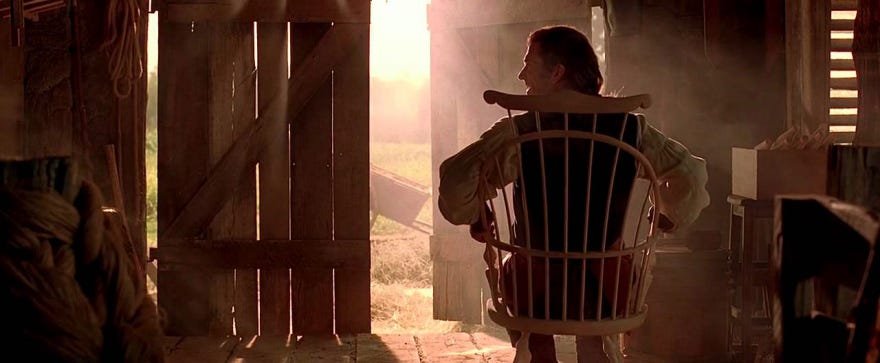
Mel Gibson as Benjamin Martin
That Benjamin Martin isn’t a historical figure but a loose composite of Francis Marion, Thomas Sumter, Andrew Pickens, and a few other Revolutionary guerrillas doesn’t really matter. He is Mel Gibson. He is very colonial. He has an excellent ponytail. He sits down in his new chair, smiles hopefully…and it collapses beneath him. Another one for the scrap pile.
Benjamin is father to a small battalion of children: seven, according to Wikipedia, though it feels like twice that. He lives on a South Carolina farm worked by “freed” servants rather than enslaved people—a bit of historical alchemy the film asks us to overlook.
He has lost his wife. He will soon lose—spoiler alert—not one but two sons to a cartoonishly sadistic British colonel played by Jason Isaacs. These losses generate enormous sympathy in the viewer, aided by the fact that Gibson, whatever else one might say about him, is a gifted actor who summons more feeling with a trembling lip or furrowed brow than most performers manage across an entire film.
Gibson stabilizes what is, in many ways, a pretty ridiculous movie. The Patriot embodies the meme: Guys will see this and just think Hell Yeah.
The violence is gratuitous and—because we’re rooting for Gibson/Martin—deeply satisfying. Legs are blown off; tomahawks buried in redcoat skulls; one unfortunate soldier is cleanly decapitated by artillery fire. Hell yeah.
The British themselves are comically inept and ahistorically monstrous. Like Star Wars‘ stormtroopers or Star Trek‘s redshirts, the British redcoats are very bad at aiming their weapons but really good at dying.
They’re sneering and posh; only a single colonial Loyalist makes an appearance. They execute prisoners in cold blood. They lock women and children in a church and burn it to the ground—an atrocity borrowed wholesale from the Nazis. That the actual British Army did none of this is, again, beside the point.
There’s also a strange romantic subplot in which Benjamin courts his dead wife’s sister, because, as a Reddit commenter notes,“that’s what you did in revolutionary days: Your wife died, you took the next sibling up. Revolutionary rules. No take backs.”
I’ll leave these apparent flaws aside.
For now, let’s simply note what we have in our protagonist: a guy who wants nothing more than to live quietly with his family and finally make a rocking chair that holds his weight. Reality, of course, intervenes. The chair breaks; an assembly convenes in the city.
The Martins travel to Charleston. The Continental Army has secured support from eight colonies and wants South Carolina to make nine. Benjamin’s two eldest sons—young, idealistic, spoiling for a fight—are desperate to enlist. But will their father, a decorated veteran of the French and Indian War, join them?
He has good reasons not to. In a burst of courtroom theatrics, Benjamin lays out his case against the war:
“Why should I trade one tyrant three thousand miles away for three thousand tyrants one mile away?”
“An elected legislature can trample a man’s rights as easily as a king.”
“Should the colonies govern themselves? I believe they can, and should. But if you’re asking whether I’m willing to go to war with England—the answer is no.”
He calls for “alternatives to war” before stating flatly: “I will not fight.”

Impartial Morality vs Loyalty-Based Morality
In his essay “Is Patriotism a Virtue?” Alasdair MacIntyre distinguishes between two fundamentally opposed ways of thinking about morality.
The first, impartial morality, is our Enlightenment inheritance: moral rules should apply equally to everyone, everywhere. Giving special priority to your own nation is a form of bias—an accident of birth. It is a Kantian, universalist ethic: all men are created equal, killing is wrong, and, as Noam Chomsky puts it, “if an action is right (or wrong) for others, it is right (or wrong) for us.”
The second, loyalty-based morality, flips this entirely. Your moral life is rooted in particular attachments—to family, community, nation, etc. You feel gratitude for your country’s gifts, responsibility for its sins, and a duty to make it better.
Sounds like patriotism, right?
To some degree, loyalty-based morality requires a value judgement on the part of the patriot, a willingness to say out loud what he believes in his heart of hearts—his country is the best in the world—just as he would prioritize his children over those of strangers. For MacIntyre, drawing on Aristotle, this partiality isn’t a flaw but a feature of virtuous, coherent societies.
The tension between these two frameworks is, MacIntyre argues, irreconcilable. Nowhere is this tension more acute than in America, a nation founded on Enlightenment universalism (”all men are created equal”) yet sustained by appeals to patriotic sacrifice and military action. We’re sort of a hybrid state: a neutral liberal space on weekdays that expects flag-waving loyalty on holidays and in times of war.
It can be an exhausting double life: we aspire to impartial moralities but when shit hits the fan we default to loyalty-based ones.
Benjamin Martin, at the film’s outset, is firmly in the impartial camp. He views the conflict through a cool cost-benefit analysis: why sacrifice my family for an abstract American nation?
In MacIntyre’s terms, he’s a citizen of nowhere, tending his farm, fiddling with his rocking chair, waiting for the whole thing to blow over.
Benjamin’s impartial morality, however elegant in theory, doesn’t survive contact with the film’s Big Bad, Colonel Tavington.

Evil incarnate
The inciting incident arrives swiftly. British forces descend on the Martin farm. Gabriel is captured. And Thomas, after attempting an ill-advised rescue of his brother, is shot point-blank by Tavington.
And now Daddy’s angry. Reason is out the window. There’s no detached calculation of British lives versus American lives or conceptions of “liberty,” “freedom,” or anything else.
Benjamin arms his two youngest sons and ambushes the British patrol in a startlingly violent sequence. They kill twenty men—a strong K/D ratio—and rescue Gabriel.
This is loyalty-based morality in its rawest form. Perhaps not yet MacIntyrean patriotism but primal defense of kin. Soon after, Benjamin agrees to form a militia and join the fight against the British.
What follows is the fun-and-games portion of the film—guerrilla raids, supply lines disrupted, redcoats humiliated. Notably, Benjamin doesn’t fight alongside the Continental Army with its formal ranks but instead leads a rag-tag militia of neighbors: local men, church parishioners, drunks from the tavern, a formerly enslaved man fighting for freedom.
MacIntyre would appreciate this. He was skeptical of large nation-states, preferring smaller communities where genuine loyalty can take root. Benjamin’s men aren’t fighting for an abstract American Empire but their neighbors, their church, their wives—patriotism as a lived attachment to known people and actual places.
In the film’s final act, Gabriel dies too, lured into a trap by Tavington. If you’ve seen The Patriot, you remember the moment. It’s gut-wrenching and well-earned.
Benjamin cradles another dead son. The temptation is despair, or worse—a nihilistic rage that mirrors Tavington’s brutality. What’s the point if everyone you love dies anyway?
The final battle’s climax—loosely based on the Battle of Cowpens—answers this. The American line is faltering, men breaking, and Benjamin—exhausted, gutted by loss—sees the fallen flag in the mud. He picks it up, charges forward, rallies the troops. The men follow. The line holds. It’s corny, it’s schmaltzy, it works anyway.
The flag is no longer an abstraction. Benjamin has lost two sons. He has every reason to walk away but doesn’t. He’s now bound up in something larger than himself, not humanity in general but this ragged, improbable nation in particular. He has become, in MacIntyre’s terms, a patriot.
George Orwell offers a useful distinction here. In “Notes on Nationalism,” he writes: “By “patriotism” I mean devotion to a particular place and a particular way of life, which one believes to be the best in the world but has no wish to force on other people. Patriotism is of its nature defensive. Nationalism, on the other hand, is inseparable from the desire for power.”
Benjamin, by this measure, is a patriot—fighting to defend home and community, not to conquer. Tavington is the nationalist: loyalty instrumentalized for power.

So what does a twenty-five-year-old Mel Gibson movie have to do with us? More than you might think.
We live in a moment of disenchantment with collective narratives. What remains is default liberalism: individual rights, personal freedom, happiness defined privately. Not a bad inheritance, but it leaves a hole where shared purpose used to be.
The question MacIntyre poses, and The Patriot dramatizes, is whether we can recover loyalty-based morality without tipping into something ugly.
No doubt, there’s a rich marketplace of boutique loyalty moralities to choose from: mean-spirited, FAFO-flavored MAGA nationalism; identity-focused progressivism for whom every opponent is a fascist; tech-bro accelerationism committed to disruption and product-market fit; wellness-influencer spirituality loyal only to self; etc.
The trick is to find a big, unifying patriotism around which most of us could rally. A massive challenge, to be sure. But I remain convinced that ninety percent of Americans are basically decent, hardworking people of various political persuasions who could get along fine if given half a chance. Over the coming weeks, we’ll explore how thinkers on the left and right are grappling with this possibility.
Until then, we’re all a bit like Benjamin at the start of the film, tinkering with our rocking chairs, just wanting to be left alone with our families in our own domestic spheres. There’s a clever scene midway through when Benjamin enters Cornwallis‘s office as part of a formal parley. The room is filled with fine English furniture, including—yes—a rocking chair. He studies it, takes a seat, marvels at the craftsmanship.
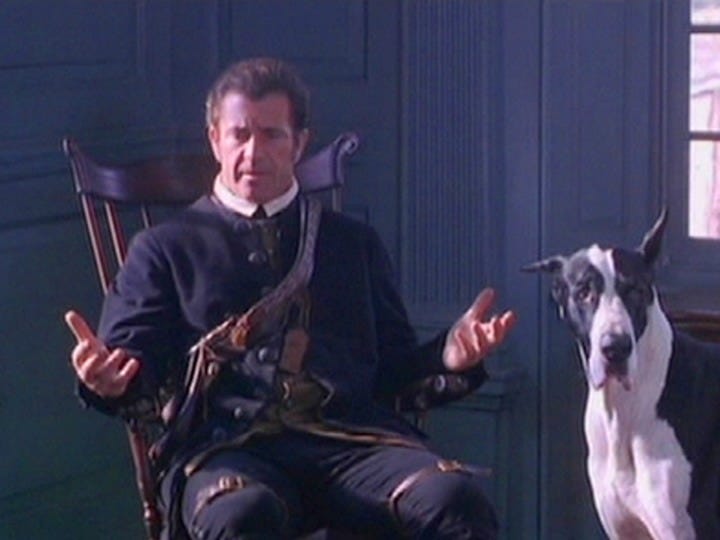
But then it’s back to war. Back to the fight for independence.
Hell yeah?

Checkpoint
Path A:
Do you see a viable path forward for particularist, loyalty-based morality—a healthy tribalism, without the warts? The idea that we naturally, and rightly, have stronger duties to family, community, and nation?
Path B:
Or should we commit to universalist morality and hope others come to see the light of impartial ethics—the idea that we should treat everyone equally, with no special consideration for our own?
Choose below. We’ll continue exploring this theme over the coming weeks!