

Save The Shire
On Palantirian Patriotism


Alex Karp—the wild-haired CEO of Palantir, former student of Jürgen Habermas, once a self-proclaimed socialist living in Germany, now a flag-waving defense hawk—wants YOU to pick a side.
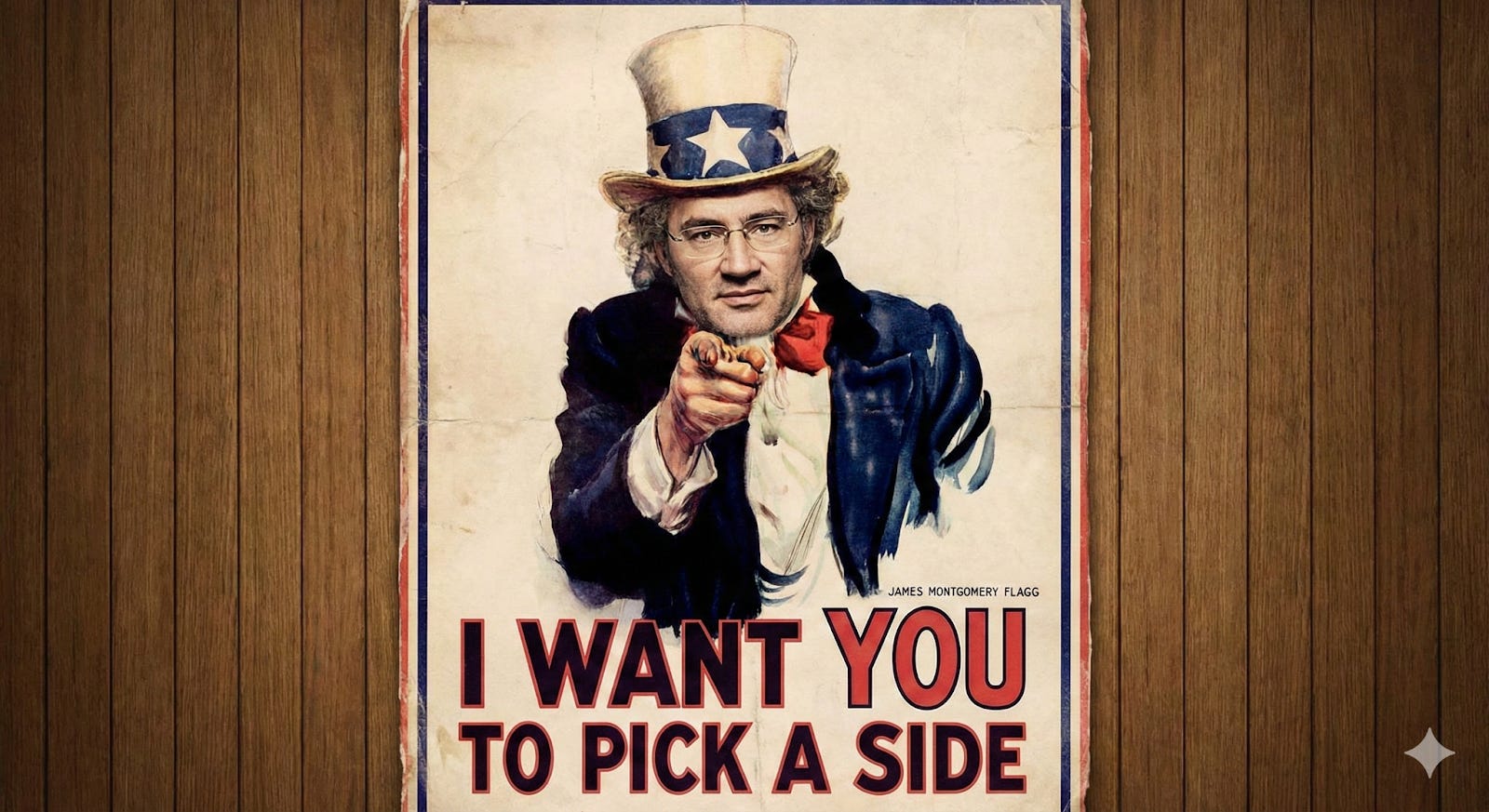
What are the two sides?
The West and the Rest, as Niall Ferguson has memorably put it.
In this telling, the West means liberal democracy, capitalism, science, progress—the Enlightenment package. The Rest represents the rejection of that order: illiberalism, autocracy, and the subjugation of the individual to the state. China, Russia, Iran.
It’s a crude map—Karp knows it, and his critics know it—but crude maps are easier to act on. And we need to act, according to Karp, because there are enemies at the gate and too few people building the alliances, systems, and weapons to stop them.
In The Technological Republic, published in 2025, Karp argued that the tech elite have forgotten where they came from. There was a time when great minds—Oppenheimer, Einstein, von Neumann—served the national interest directly, when institutions like NASA and DARPA channeled American ingenuity toward collective goals. That spirit has evaporated. Today’s corporate giants build products that distract and divide, and for Karp, the Metas and Googles of the Western world peddle little more than digital opium.
He believes big tech sold out. Instead of serving the country, it serves consumers alone. Karp looks back ruefully on the dawn of Facebook and Grubhub: “The age of social media platforms and food delivery apps had arrived,” he writes. “Medical breakthroughs, education reform, and military advances would have to wait.” The smartest engineers are optimizing for ad-clicks rather than infrastructure projects, healthcare innovations, or national defense.
Karp seems most frustrated with the white-collar laptop class: tech workers, New York Times subscribers, NPR donors, people who went to good schools and live in nice cities and fly Ukrainian flags but recoil at the defense budget. Across interviews, shareholder calls, and his sprawling manifesto, he’s tried to grab enlightened liberals by their quarter-zips and shake them to attention. Join the fight. Defend the West. Be a patriot. Not blindly nationalistic, but committed to the American project.
Karp is an unabashed ideologue, idealist, and idea guy. He quotes Heidegger and speaks (constantly!) of “ontologies.” He rails against moral relativism. Sometimes, he insists, the world really is black and white. Good and evil are real forces—as real as tables and chairs.
Critics call this worldview Manichaean—a far too simplistic reduction of the world into two sides. And it is. Karp would probably admit as much. Pressed on the nuances of China or Russia, he’ll usually grant that things are complicated. But when it’s time to build, to ship, to defend, the nuances fall away. The map gets simple: the Shire must be defined, idealized, and finally saved.
At Palantir, they take this literally. The company’s tagline is “Save the Shire,” emblazoned on T-shirts and visitor badges. Employees call themselves Hobbits. Offices are named after Tolkien locations: the Shire, Rivendell, Minas Tirith.
The original quote comes from Frodo himself: “I should like to save the Shire, if I could—though there have been times when I thought the inhabitants too stupid and dull for words.” I suspect Karp relates to the second half of Frodo’s statement as much as the first.
But what does it actually mean to “save the Shire” ?
In Tolkien’s universe, the Shire is the hobbits’ homeland—green hills, small farms, a peaceful way of life with pipe-weed and ale. It’s so safe that its inhabitants have forgotten danger exists. The hobbits who venture out to fight Sauron do so precisely so that the ones who stay behind never have to know what almost happened.
Palantir’s version of the Shire is America, or the West more broadly. Democracy, rule of law, freedom of speech: all the things we take for granted, protected by powers we’d rather not think about, against enemies we’d prefer to believe don’t exist.
What are we to make of this metaphor? Must the Shire be saved? And how should the everyday person—proud to be American but uneasy about its worst excesses—think about this framing?
What is Palantir?
Palantir was co-founded in 2003 by Peter Thiel and Karp after they met at Stanford Law School. Thiel, the libertarian, named the company after the “seeing stones” in Tolkien’s Lord of the Rings—mystical orbs that allow users to see events far away. Karp, the Marx-quoting philosophy PhD, eventually became CEO. They’ve been arguing about politics for nearly thirty years. Somehow, they run a company together.
Karp grew up with a Jewish father and a Black mother. He has said he came to believe that “if fascism comes, I’d be the first or second person on the wall.” The West, in his own self-mythology, is the only civilization capable of protecting someone like him.
So what does Palantir actually do?
It’s less mysterious than the Tolkien branding or breathless media reports might suggest. At its core, Palantir builds software that helps large organizations—governments, corporations, militaries—integrate and analyze data they already have.
Think of it as a very sophisticated consulting firm with very sophisticated tech: “Palantirians” take the messy databases a company or agency has accumulated over decades, stitch them together, and make them searchable and useful.

Palantir’s Ontology System
If the U.S. conducts a drone strike and kills a suspected terrorist in the Middle East, Palantir platforms may well have been used to locate the target. If ICE shows up in a Chicago suburb to detain someone on their way to work, Palantir software may have helped find them too.
The CIA was an early investor through In-Q-Tel. The FBI, NSA, CDC, and Defense Department are all clients. So are Airbus, AWS, Morgan Stanley, Bank of America, Exxon Mobil, IBM, Citibank, Annheuser Busch, Ferrari—the list goes on and on.
Did Palantir help find Osama bin Laden? Karp isn’t going to dissuade you of that idea. The mystique helps land contracts.
Palantir has many critics. Civil liberties groups worry about the surveillance implications. Immigration activists have protested the company’s work with ICE. Thirteen former employees publicly accused Palantir of “normalizing authoritarianism”—something Karp has called “malarkey.”
And yes, Karp is incentivized to bang the patriotic drum—Palantir’s market cap now exceeds $400 billion, making it one of the most valuable tech companies in America.
“We have dedicated our company to the service of the West and the United States of America,” Karp said in a recent update to investors. “Palantir is here to disrupt and to make the institutions we partner with the very best in the world—and when it’s necessary…to scare enemies and, on occasion, kill them.”
It’s jarring language for a shareholder call. But Karp would say that’s the point, that we’ve become too squeamish to say out loud what defense requires. And he’s not alone.
Anduril, and What Lies Beyond the Shire
Palmer Luckey, the founder of Anduril, also likes to talk about killing bad guys. Perpetually in flip-flops and a Hawaiian shirt, he’s built a company that makes autonomous drones and defense systems—and he named it, you guessed right, after Aragorn’s sword in Lord of the Rings: the blade that was broken and reforged to defend the West.
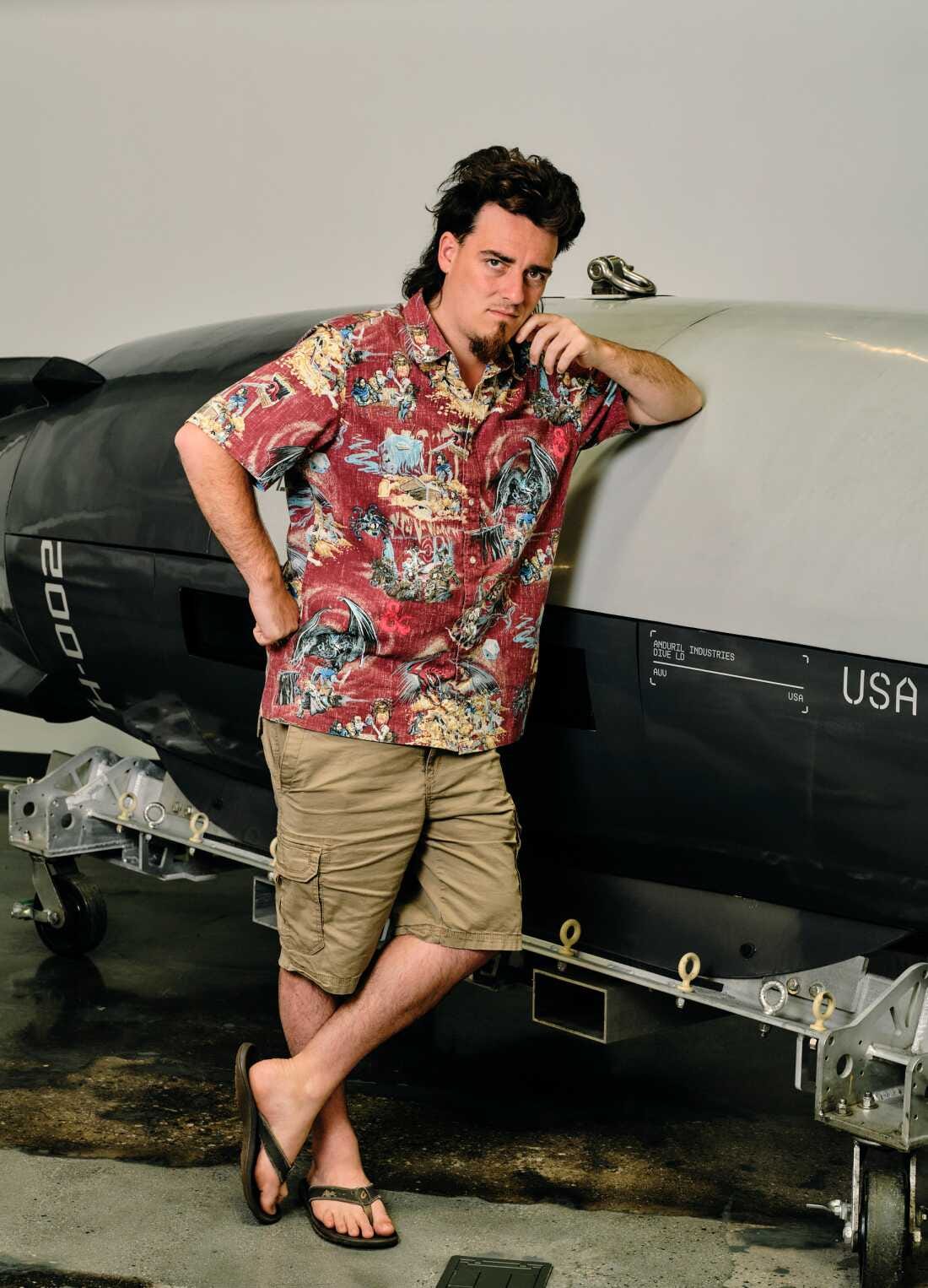
Palmer Luckey
Luckey’s been asked how he could name a weapons company after Lord of the Rings. Didn’t Tolkien hate war?
His answer: Tolkien wasn’t pro-war, but he believed in good and evil, and he believed some wars must be fought. One theme of the books, Luckey points out, is that hobbits who live far from Mordor can’t quite believe the monsters are real.
“I think that describes a lot of Americans,” Luckey said in a recent interview. “You’ll talk to people that say, ‘Nobody’s truly evil, nobody deserves to die.’ There are people on the frontlines who don’t have the luxury of that. Someone who’s looked evil in the eye can’t pretend it doesn’t exist.”
C.S. Lewis, Tolkien’s close friend, put it this way:
The central theme of [The Lord of the Rings] is the contrast between the Hobbits (or “the Shire”) and the appalling destiny to which some of them are called, the terrifying discovery that the humdrum happiness of the Shire, which they had taken for granted as something normal, is in reality a sort of local and temporary accident, that its existence depends on being protected by powers which Hobbits forget, against powers which Hobbits dare not imagine.
This is the worldview underwriting both companies. There are dark powers in the world, and Karp and Luckey have cast themselves as the heroes who must fight them.

Anduril’s autonomous fighter jet
The CCP has detained over a million Uyghurs in internment camps. Russia poisons dissidents with nerve agents. Assad gassed Syrian civilians. Iran executes women for defying hijab laws. North Korea’s prison camps have killed hundreds of thousands. These aren’t fantasies.
No doubt, Western governments have committed grave abuses of their own—Abu Ghraib, unlawful drone strikes, and Israel’s devastating campaign in Gaza among them. I’m not going to relitigate those here.
Karp’s argument isn’t that America is innocent but that America can be argued with and within. It has courts, elections, and a free press. When things go wrong, there’s a mechanism for self-correction. You have to pick a side, and he picks the one that can fix its mistakes.
Maybe. Wrapping all this in Tolkien’s mythology does a lot of work—it makes the moral calculus feel cleaner than it actually is.
Is this what Tolkien actually meant?
The question has haunted the books since publication. Tolkien would have been suspicious of anyone who used his mythology to cleanly sort the world into heroes and villains. In a 1944 letter to his son, he put it plainly:
Yes, I think the orcs [are] as real a creation as anything in “realistic” fiction ... only in real life they are on both sides, of course. For “romance” has grown out of “allegory”, and its wars are still derived from the “inner war” of allegory in which good is on one side and various modes of badness on the other. In real (exterior) life men are on both sides: which means a motley alliance of orcs, beasts, demons, plain naturally honest men, and angels.
When Peter Jackson’s films came out during the Iraq War, Viggo Mortensen appeared on Charlie Rose in a homemade t-shirt: “No More Blood For Oil.” He was mortified that people were projecting post-9/11 politics onto Tolkien. “I think they see the U.S. government as Saruman,” Mortensen said of Iraqi civilians.
Tolkien served in the trenches at the Somme, and two of his closest friends died there. He believed Hitler had to be fought, but he also wrote to his son that “Wars are always lost, and The War always goes on.” Even a good war ends with much that should have been cherished lost.
Lord of the Rings is capacious enough that people project onto it whatever they need. Hawks see a call to arms. Doves see a meditation on power’s corruption. Tolkien would probably say both are missing the point.
And that’s exactly what Karp and Luckey are doing: using Tolkien to simplify their own moral universe. The Shire is good. Mordor is evil. Pick a side. It’s a useful story for men who build weapons for a living.
The Two Operating Systems
Here’s the tension at the heart of all this. As I touched on in my analysis of The Patriot, most of us are running two moral programs at once, even though we often don’t realize it and the programs often don’t sync up.
The first is Enlightened liberalism: evaluating actions by universal principles rather than tribal loyalty. This operating system is intellectually honest and acknowledges complexity. It worries about civil liberties and due process. But it’s cerebral, maybe too cerebral—it struggles to motivate anyone to do anything hard.
The second is loyalty-based patriotism. This one has force behind it. It can mobilize resources, inspire sacrifice, and stir hearts. But it’s also prone to blind spots, nationalism, and injustice, and it has a way of convincing people that their side is always right.
For the most part, Karp and Luckey run the second program. They’ve decided that a crude map is better than a nuanced one that paralyzes you. Save the shire; kill the “bad guys;” let history judge.
Meanwhile, many of us want to run the first program, but we end up like Chidi from The Good Place: stuck in analysis paralysis, frozen by the complexity of it all. Well, is that the right thing? What about this consideration? And that one? By the time we’ve finished deliberating, someone else has already acted.

Chidi, professor of moral philosophy
This is the bind. Palantirian Patriotism has real advantages—clarity, coherence, the ability to actually get things done. But it comes at a cost: the willingness to look away when your side does something ugly.
Many of us are yearning for the benefits of that clarity but without the moral compromises. We want a simple map that doesn’t require us to pretend the map is the territory.
It’s an immense challenge: to simplify with nuance. I think it starts with something Richard Rorty wrote in Achieving Our Country:
You cannot urge national political renewal on the basis of descriptions of fact. You have to describe the country in terms of what you passionately hope it will become, as well as in the terms of what you know it to be now. You have to be loyal to a dream country rather than to the one to which you wake up every morning. Unless such loyalty exists, the ideal has no chance of becoming actual.
Rorty creates a bridge between the two operating systems. We cannot simply retreat into the safety of the Shire and pretend the orcs aren’t real, nor can we blindly follow the war hawks and accept that the defense of the West justifies every excess.
The challenge for the modern patriot is to hold these two thoughts simultaneously: to acknowledge that the Shire requires protection, sometimes by rough people doing rough things, while stubbornly insisting that the Shire must remain a place actually worth saving.
How we define that “dream country”—a new Shire worthy of both our critique and our defense—is where we’ll pick up next time.
CHECKPOINT
Path A: Pick A Side. The world is dangerous. We must prioritize the defense of our own civilization and accept that “saving the Shire” requires decisive power, aggressive methods, and prioritizing “us” over “them.”
Path B: Principles Over Power. The world is complex. We must adhere to universal standards of justice and refuse to simplify the map, even if that moral consistency slows us down or leaves us vulnerable to enemies who don’t play by the rules.
In the real world there is no shire. The west is an outdated framing of the world. These weapons makers are more like Celebrimbor at best and at worst Sarumon. These companies will take whatever contracts they can get and are not going to ask whether it’s right or not and not going to ask whether these weapons are trained on the shire.
I want to get to the Star Trek future. I want the one where we figure it all out and survive together. That will not happen without a dedication to principles over the tribe.