

Rule Yourself
The case for playing one's own games

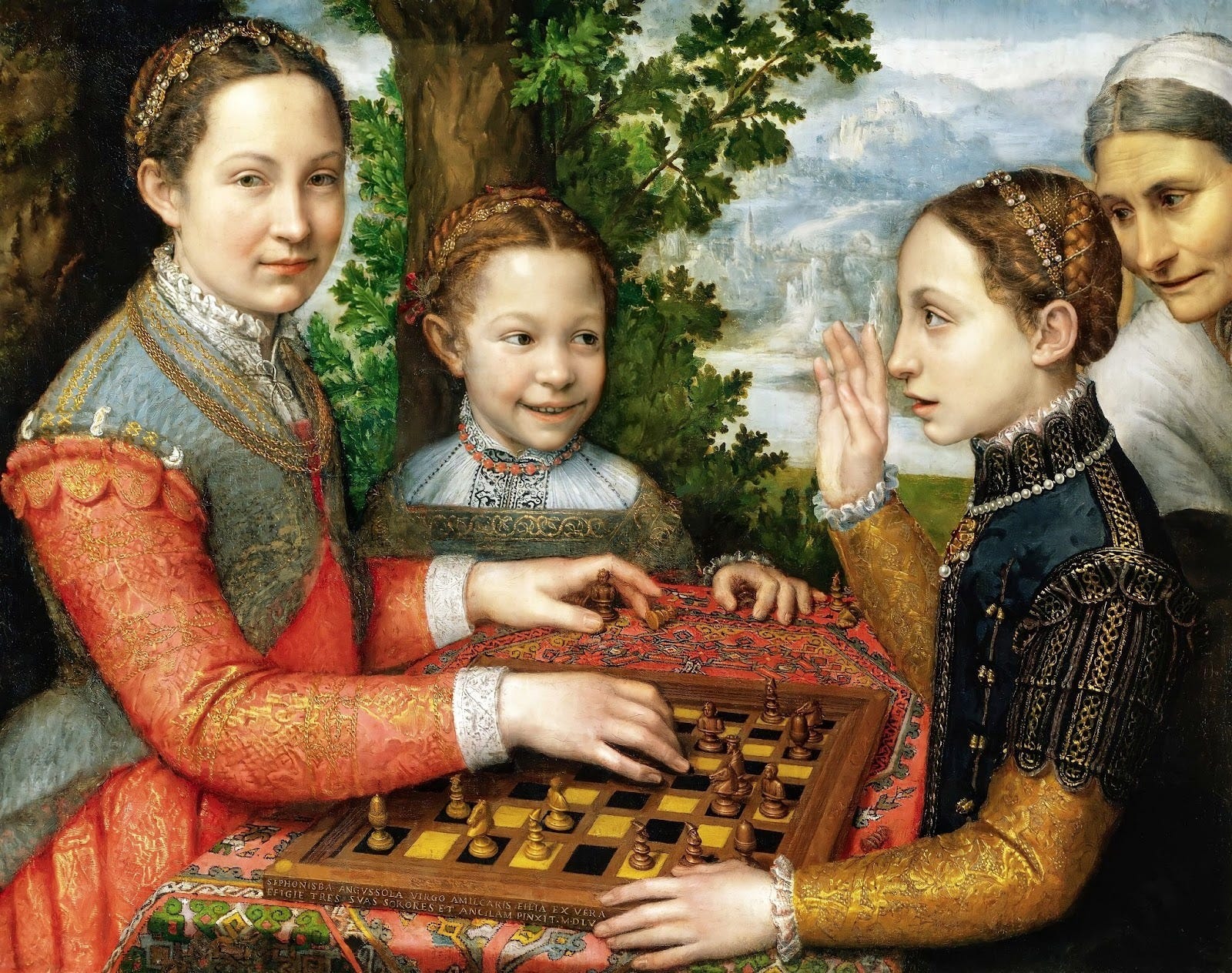
The Chess Game, Sofonisba Anguissola, 1555
Among philosophers of games, there’s a singular definition of what games are that’s outlasted all challengers. It comes from the Canadian theorist Bernard Suits, who published the famous sentence in 1978.
It goes like this:
“Playing a game is the voluntary attempt to overcome unnecessary obstacles.”
Suits’ formulation is worth reading again; there’s not a word out of place. Playing a game is the voluntary attempt to overcome unnecessary obstacles.
Nobody forces you to play Chess. The rules are arbitrary and occasionally absurd: try explaining en passant to a seven-year-old. But the constraints are the point. They create what the Dutch historian Johan Huizinga called a “magic circle,” a bounded space in which our minds, free of outside concerns, can strive within defined boundaries.
Every game I can think of meets Suits’ recipe card of (1) voluntarily (2) attempting to (3) overcome (4) unnecessary (5) obstacles. What’s interesting is that a lot of other things do too.
Some say Suits’ definition covers too much ground. Thomas Hurka pointed out that a motorist who obeys the speed limit—accepting a less efficient means to get home in order to avoid a ticket—satisfies every element of Suits’ definition, yet is plainly not playing a game. John Tasioulas went further: if we follow Suits’ logic, entire institutions—courts, armies, churches—start to look like games too.
Suits was untroubled. He was prepared to count a wide array of activities—math exams, mountain climbing, marathon running—as games in his technical sense. In his view, the problem isn’t that the definition is too broad but that our ordinary idea of what counts as a game may be too narrow.
Suits is basically James Franco in This Is the End, echoing the actor’s comically broad definition of art but applied to games.
You go to school? You got a job? Guess what, buddy? Those are games.

I want to focus on the “unnecessary obstacles” part of Suits’ equation.
Game designers have always known that the specific rules and restrictions you place on a player are where the magic happens. The fun is never in total freedom—many of the most open, most permissive video games flop for precisely this reason. The fun is in the constraints.
But there’s a flip side to this. Sometimes we’re trapped in games we don’t really want to be playing…with rules we didn’t make…on boards we didn’t build. This is society’s cost of entry: you’re dropped onto the chessboard of the world in the mid-game and left to figure out what the pieces do.
And so you play along. You follow “the rules.”
You whisper in empty libraries. You tip 20 percent on bad service. You optimize for metrics—step counts, follower counts, quarterly numbers—that somebody else decided were the score.
C. Thi Nguyen calls this value capture: that moment when a simplified metric quietly replaces the richer value it was supposed to represent. GPA replaces education, salary replaces vocation, the number on the scale replaces overall health.
The game eats the thing it was meant to measure. And most of the time you don’t notice because the rules feel like reality.
But they aren’t.
Today’s quest will take a somewhat unusual tack. Instead of starting with life and layering on game metaphors, I’ll start with games and work backwards. Game designers have spent lifetimes building rule systems that shape human behavior. They know which types of constraints produce focus, which produce creativity, and which produce misery. Not all rules are created equal. Understanding how they work inside games might help us recognize them outside games.
Some rules can be bent. Others can be broken. But first you have to see them.
What follows won’t be a strict taxonomy but a walking tour of a few rule types, borrowed from actual games, that you might find useful in daily life.
Game Rules You Can Steal
Sid Meier once defined a game as “a series of interesting decisions.” To the extent that games are games—and that games are fun—they give players constrained choices that involve trade‑offs and consequences, so their decisions actually matter.
What follows are three constraint types that game designers use to manufacture interesting decisions. They work in games. They also describe, with uncomfortable precision, many of the mechanics already running your life, whether you designed them or not.
1. Inventory Limits
The Resident Evil series has spent three decades refining a single design insight: if the player can carry everything, nothing matters. Therefore, your inventory is limited to a handful of slots.
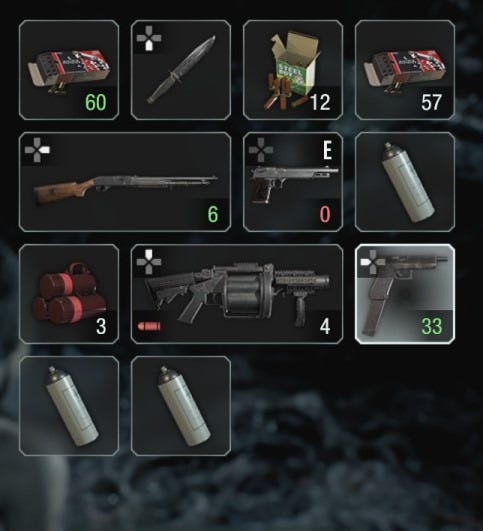
Resident Evil’s inventory system
Every weapon, every key, every box of ammunition must compete for its spot. The horror of the games is as much about resource anxiety as it is about zombies, and the series has never abandoned the constraint because the constraint is the game.
Eiji Aonuma, series producer of The Legend of Zelda, discovered the same principle from a different angle. In Breath of the Wild, weapons break. Players hated it at first.
Aonuma’s explanation was precise: “If you have this nice weapon, but you know it’s going to break, you have to start thinking about when am I going to use it? What enemies am I going to use it on?”
Durability turned every encounter into an inventory decision: do I spend this weapon here or save it? Nintendo didn’t remove the system in the sequel. It was fun—and true to life.
Inventories function in games the way they function everywhere: as a forcing mechanism for priority. They turn you from a mindless acquirer of stuff into a thoughtful curator of purposeful objects.
We create big inventories when we go on vacation (sunscreen, swimsuit, flip-flops), small inventories when we leave the house (phone, wallet, keys), and all manner of mental inventories that can stress us out if we don’t tend to them: running lists of errands, stacks of open commitments, things we’re “carrying” that we haven’t examined in months.
Fortunately, tackling inventory management head-on can be—in a word—fun. Notice the quiet flow state you might find when packing a bag. Okay, I need this. Now I need this. Now this. There’s a reason it feels satisfying. It’s a small, solvable inventory game—a grid with edges, a set of real constraints, and a clear objective.
Like any game, inventorying can be improved upon. I’m no expert on the art of curating what you carry, but I can point you to people who are: Marie Kondo’s The Life-Changing Magic of Tidying Up is the obvious entry point, but deeper reads include Fumio Sasaki’s Goodbye, Things—a philosophical case for radical subtraction—and Donald Norman’s The Design of Everyday Things, which reframes the objects in your life as interfaces you’re either designing well or badly.
2. Class Restrictions
Ask someone what they do for a living, and there’s a good chance they’ll squirm. Many people describe a cloud of activities—writing, consulting, managing, building, advising—because committing to a single pursuit feels like giving something up.
And it is. Games understand this.
D&D’s original class system was a social contract between players. As Walt Ciechanowski, a longtime gamemaster, writes at the tabletop blog Gnome Stew: “Each class specialized in things the other classes couldn’t. Only together could they form a balanced team, with each class shining at the appropriate time.”
The fighter couldn’t heal himself. The cleric couldn’t use bladed weapons. The wizard could reshape reality but died if you sneezed in his general direction. Every player was essential because every player was incomplete.
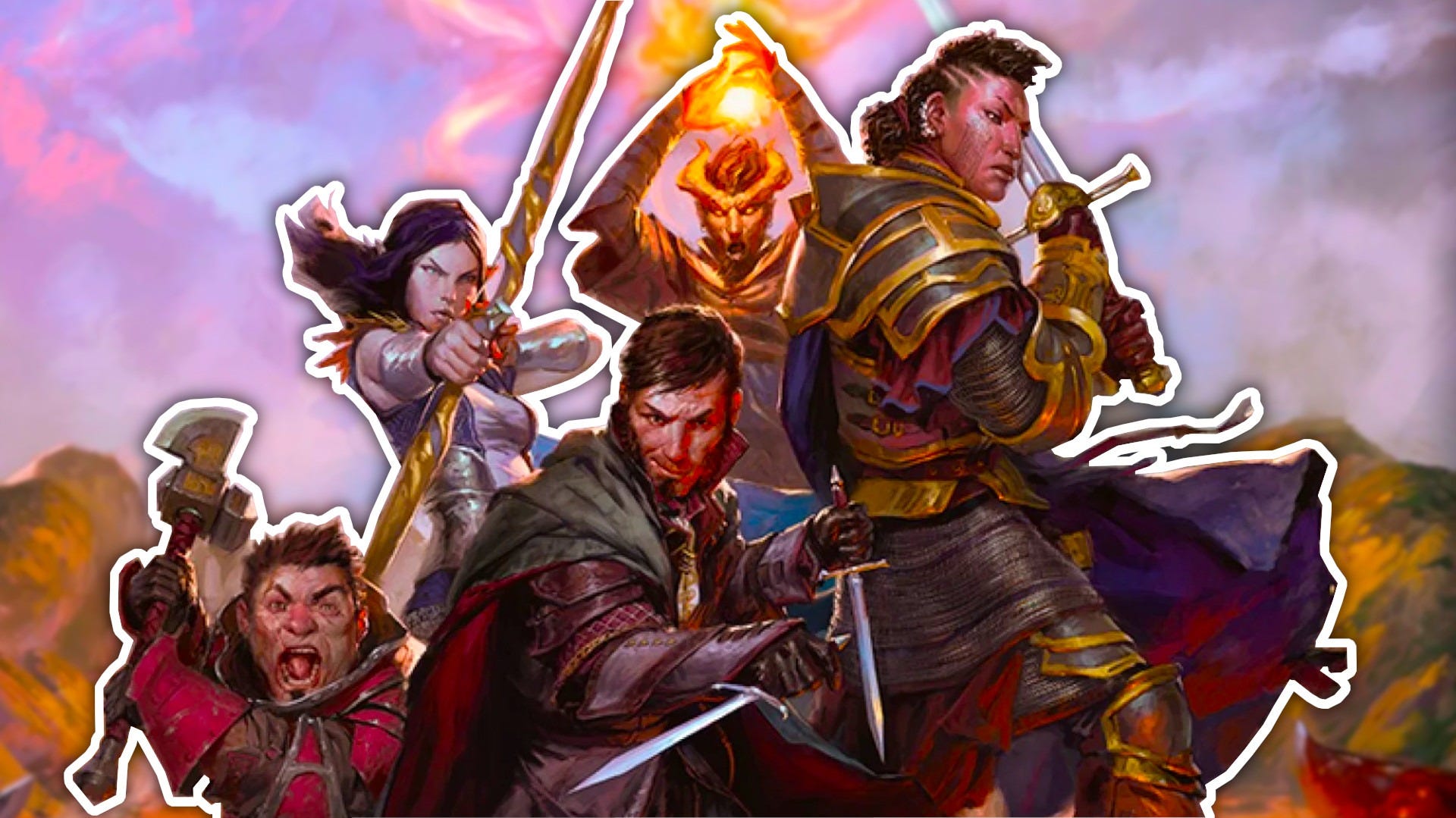
Choose your class
Classes are everywhere in games—from D&D to World of Warcraft to Final Fantasy—because they solve a problem that open-ended freedom cannot: they tell you who you are. Mark Rosewater, who’s spent decades designing Magic: The Gathering, landed on a counterintuitive truth: “Your job as a game designer is to force your players to have to be creative to overcome the restrictions you create.” Restriction spurs creativity, and classes restrict identity—for the better.
Pete Davis makes the real-world version of this argument in Dedicated: The Case for Commitment in an Age of Infinite Browsing. His thesis is that we live in a culture of “infinite browsers”—people who keep every option open, sample everything, and commit to nothing. Americans in particular resist class selection. We want to be the writer who also invests, the consultant who also paints, the engineer who’s really a musician.
The result is often a kind of paralysis dressed up as flexibility. Davis argues that depth, mastery, and genuine satisfaction come from closing doors, from picking a path and sticking to it. The book is, in essence, a case for choosing your class.
It’s easy to multiclass yourself into oblivion: to be a jack of all trades and master of none. Of course, there’s nothing wrong with breadth, with being a well-rounded generalist. But often the builds that work—in games and out—are those that go deep.
3. The Nuzlocke Rule
In 2010, UC Santa Cruz student Nick Franco was bored during finals week and popped Pokémon Ruby into his Game Boy Advance. He realized he’d played through the game too many times for it to feel interesting, so he imposed two rules on himself: release any Pokémon that faints, and catch only the first Pokémon you encounter in each area.
The result was a harder game and a more emotionally resonant experience. Rather than simply increasing the difficulty, these self-created rules made him care for his monster friends more than ever before.
Two simple rules made for a completely different playthrough. He called it Nuzlocke.
Hades designer Greg Kasavin built a system around this instinct: the Pact of Punishment, a suite of modular difficulty modifiers that lets players compose their own challenge by stacking constraints. Balatro, the roguelike poker game I’ve written about previously, does something similar—fifteen different decks, each with its own rule-bending modifier, across eight escalating “stake” levels that stack cumulative restrictions on top of each other. You choose your deck, you choose your stake, and the combination produces a different game every time. The underlying philosophy is the same: difficulty is not fixed. It is something you elect to accept.
Bernard Suits saw this clearly in 1978. Every Nuzlocke run, every speedrun category, every no-hit challenge illustrates his thesis: players do not merely tolerate constraints but voluntarily adopt them, share them, and compete within them.
You can “Nuzlocke” virtually anything. This is the rule type with perhaps the most direct application outside games, because it requires no one’s permission and can be done entirely in your head. You just need a few arbitrary rules that sound interesting enough to follow.
I’ve been running a quiet Nuzlocke of my own since last year: I’ve tried to only read books about whatever is dominating the news. Iranian history has been my latest rabbit hole. It was the history of inflation when the Fed was in the headlines. The rule narrows my reading list in a way that forces depth instead of my usual scatterbrained approach. It’s turned the news cycle, which I used to find exhausting, into a kind of syllabus. I also think it’s helpful from a memory perspective: whatever I’m reading is constantly being refreshed by the headlines.
The possibilities are endless. You could Nuzlocke your cooking—one new cuisine per month, no repeats—and by December you’d have twelve competencies instead of one. You could Nuzlocke your commute: a different route every day for a month, no GPS, and see what you discover about the place you’ve lived for years without looking at. You could Nuzlocke your social life—say yes to the next three invitations that arrive, regardless of what they are, and break the pattern of only doing things you already know you’ll enjoy.
I’m planning to Nuzlocke Disney World next time we go as a family. I haven’t figured out the rules yet, but that’s half the fun: the design phase, where you decide which constraints will make the experience more interesting rather than less.
The obstacle is rarely a lack of freedom. It’s almost always a lack of voluntary constraint. So put some rules on yourself—make them weird. See what happens.

As always, thanks for reading! We’ll finish our series on Games next time. Please be sure to like the post if you enjoyed it, and comment below with any of your own interesting self-imposed constraints.