

Reclaim Patriotism
A To-Do List for Reluctant Americans

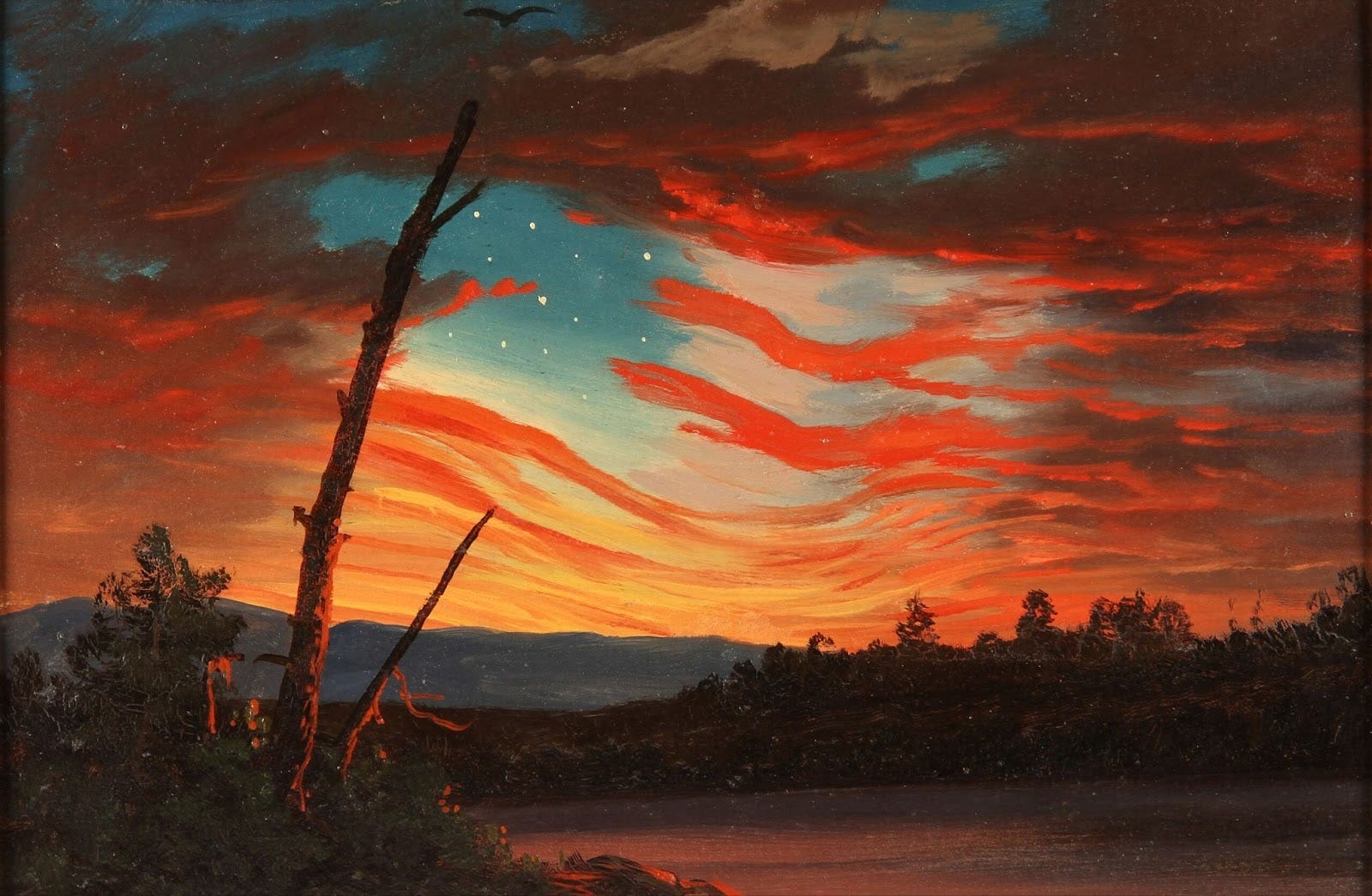
Our Banner in the Sky, Frederic Edwin Church, 1861
I don’t usually tackle politics face-on.
I tend to subscribe to Jerome Powell’s recent advice to his successor as Fed chair: “Don’t get pulled into elected politics. Don’t do it.”
Neutrality is obviously important for the face of the central bank. It’s not always important for writers — some of the best writing in history is ferociously partisan — but it matters when you’re trying to capture the curiosity of a broad audience.
At the same time, I don’t want to fall into either/or fallacies or enlightened centrism or whatever the latest slur is for people who genuinely land “in the middle”—even the left-right metaphor makes me uncomfortable—on any number of issues.
All that said, I recently revisited Jonathan Haidt’s 2012 book The Righteous Mind and was struck by his ability to write squarely about politics without either picking a team or retreating into the sort of “both sides have a point” mush that says nothing.
You might know Haidt for The Anxious Generation, his more recent and much more viral book about what phones are doing to kids. It has a catchier title and narrower thesis. But his earlier book is the one that changed how I think about politics.
In it, he offers a framework for understanding why liberals and conservatives talk past each other. He identifies six moral foundations that underlie all of human morality: Care/Harm, Fairness/Cheating, Loyalty/Betrayal, Authority/Subversion, Sanctity/Degradation, and Liberty/Oppression.
Think of them as moral taste buds. Some people taste more flavors than others, and some taste certain flavors more intensely.
Thomas Sowell arrived at something similar years earlier. In A Conflict of Visions, Sowell divided political thought into what he called the constrained vision — human beings have a fixed nature, and we must always engage in a series of trade-offs — versus the unconstrained vision: human beings are mostly the product of their cultural or socioeconomic environment, and there’s no reason we can’t solve all the problems of the world. Steven Pinker later renamed these the “tragic” and “utopian” visions.
Some of us are firmly one or the other: constrained/tragic OR unconstrained/utopian. Others—I include myself in this camp—flip-flop a bit, depending on the matter at stake or what we had for breakfast. Sometimes I feel like a Burkean conservative, skeptical that grand interventions will do more good than harm; other times I feel more like a Star Trek techno-optimist, convinced we can build our way into a better world if we just get the engineering right.
Haidt explores the space between these visions. Once we are equipped with his vocabulary, we can begin to imagine a patriotism that normal people can actually get behind.
Below, I run through five ideas for fostering a better, more functional patriotism.
I know the word “patriotism” makes people flinch; it feels like it belongs exclusively to the right. But Haidt’s research suggests that loyalty and group identity serve an important purpose, and that the left has abandoned them at a real cost.
Ceding patriotism to one side of the aisle is a mistake. What might a different version look like?
A note: feel free to skip the Haidt section and jump straight to the five ideas below. You’ll miss what I think is valuable framing, especially if you’re confused about why I care so much about “patriotism” in the first place. But if you’re short on time and just want some quick-hit proposals, go for it.
The Righteous Mind, or Why Good People Talk Past Each Other
If it wasn’t clear before, I don’t love Haidt’s title, even though I love the book. The Righteous Mind: Why Good People Are Divided by Politics and Religion doesn’t exactly leap off the shelf. But the book is really about Haidt’s frustration, as a self-described liberal, with his own side’s inability to understand why conservatives think the way they do.
Haidt is a social psychologist at NYU’s Stern School of Business, and for years he was baffled by the same thing many liberals are baffled by: how could anyone possibly disagree with us? We care about people. We care about fairness. What else is there?
Quite a lot, it turns out.
The core metaphor of the book is that our moral mind is like a tongue with six taste receptors. Haidt calls these moral foundations; they are:
Care/Harm — rooted in our mammalian instinct to protect children. We feel empathy for suffering.
Fairness/Cheating — rooted in reciprocal altruism. We want deals to be fair and cheaters to be punished. (“Fair” means very different things to different people—equality to some, proportionality to others.)
Loyalty/Betrayal — rooted in our tribal history. We form teams. We punish traitors. We wave flags.
Authority/Subversion — rooted in primate hierarchies. We respect leaders, traditions, and institutions. Or we don’t.
Sanctity/Degradation — rooted in the psychology of disgust. Some things feel sacred, others profane. Religious or not, we all have a sense of purity and contamination.
Liberty/Oppression — added later, this one tracks our sensitivity to domination. Everyone hates a bully, but how we define “bully” varies wildly.
Here’s the punch line: liberals tend to rely heavily on two, maybe three of these foundations—Care, Liberty, and Fairness. Libertarians value (you guessed it) Liberty above all. Conservatives draw on all six foundations, roughly equally. This is Haidt’s famous “conservative advantage.”
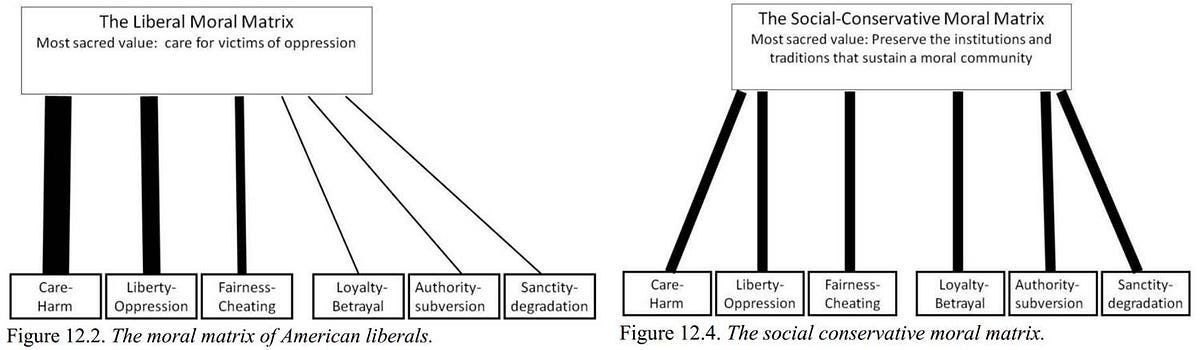
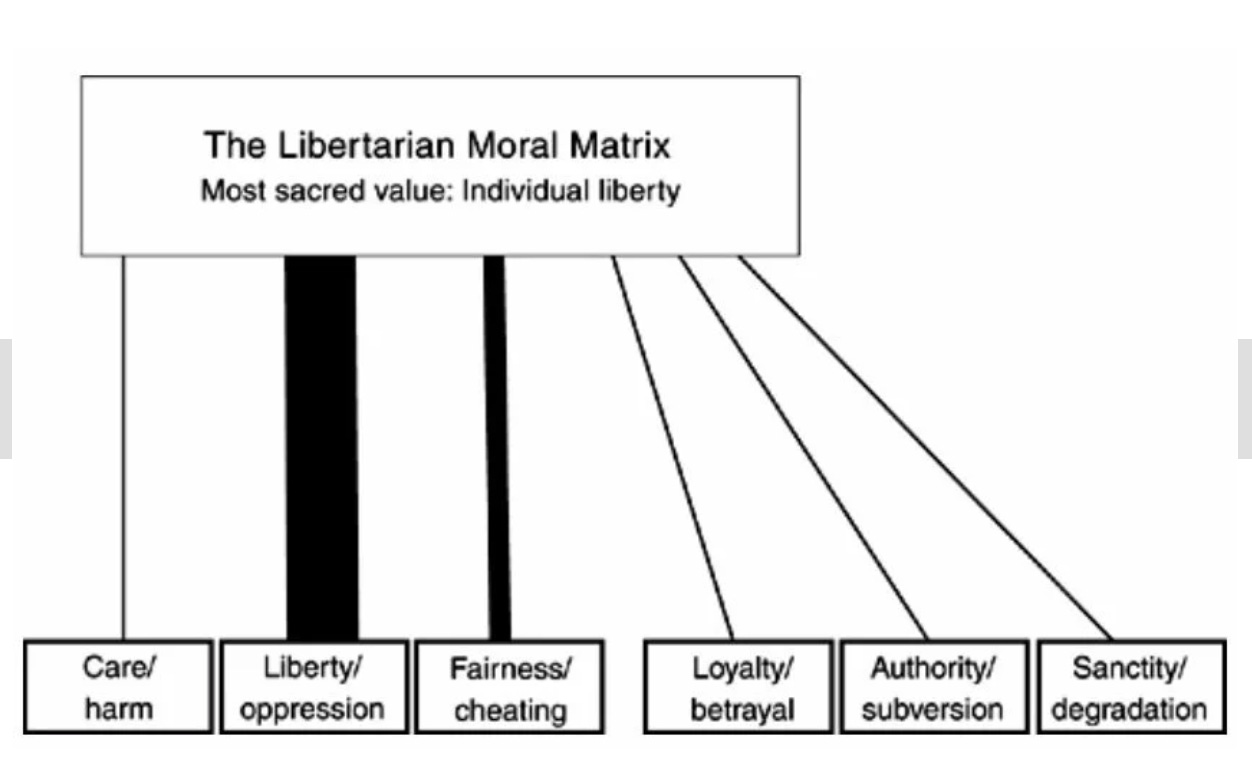
What’s the advantage? In Haidt’s view, conservative moral psychology is distributed more evenly across more foundations. A Republican politician can talk about care and loyalty and sanctity and authority. That’s a pitch with broad reach. A Democrat who leans almost exclusively on care and fairness is making a strong case but with narrower appeal.
Plenty of liberals would push back here—and fairly. It’s not that liberals are blind to loyalty or authority or sanctity. They experience those instincts too. But Haidt’s data suggests they weight them far less heavily.
His research found that conservatives are better at predicting what liberals believe than liberals are at predicting what conservatives believe. Liberals tend to assume that conservatives simply don’t care about people — that they lack the Care foundation. But that’s wrong. They just have other competing moral commitments: loyalty, order, and the sacred.
When those foundations conflict with pure care-based reasoning — when, say, national loyalty or institutional authority seems to demand something that looks “heartless” from a pure Care perspective — they’ll make the trade-off. Liberals, not weighting those foundations as heavily, can’t always see the trade-off being made. They just see cruelty.
Here, a liberal might counter that Loyalty, Authority, and “the Sacred” are old concepts that should’ve been tossed out with the pre-21st-century bathwater—that “loyalty” is merely a code for exclusion, “authority” a euphemism for domination, and “sanctity” a gaudy mask for an outdated morality. They’d argue that a worldly universalism, rooted in basic human dignity, should reign supreme.
They may be right. Often, as with the documented abuses of federal agencies, the erosion of democratic norms, or the moral vacuum of the Trump era, they clearly are. No doubt, the current administration has turned the loyalty and authority dials up to 11.
…which is exactly why it’s so important to reclaim these foundations rather than abandon them.
Democrats lose something when they completely forego the more traditional foundations like loyalty. Elections, for one thing. More fundamentally, they lose internal coherence—the ability to move together in the same direction.
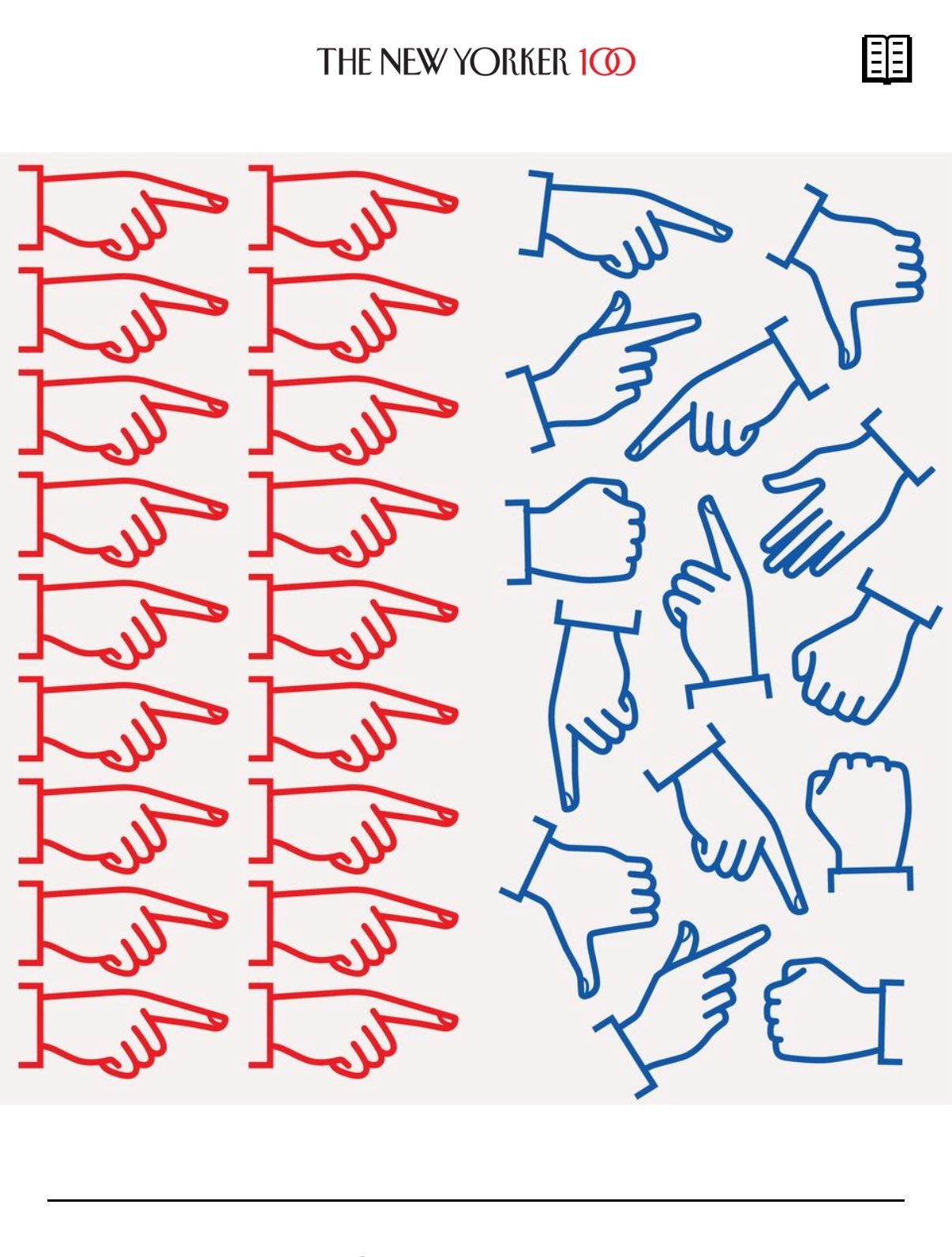
A recent New Yorker story (with brilliant cover art) made exactly this point:
“Republicans have become adept at creating broad coalitions in which supporting Trump is the only requirement. Democrats get tied up with litmus tests.”
Loyalty — the idea that you and the person next to you share something in common, that you’re on the same team — doesn’t have to mean xenophobia or zero-sum tribalism. Being a little tribal (“tribal-ish”) has its advantages. And it’s almost certainly hard-wired, anyway.
Belonging implies a boundary: an “us” and a “them.” The neuroscientist Robert Sapolsky laid this out in his book Behave. “Primates are hardwired for us/them dichotomies,” he told the Santa Barbara Independent. “Our brains detect them in less than 100 milliseconds.” Depressing as hell, he conceded, but we have one advantage over other primates. “We all belong to multiple tribes,” he said. “Even if we are predisposed to dividing the world into ‘us’ and ‘them,’ it’s incredibly easy to manipulate us as to who counts as which at any given moment.”
The goal, then, is to define “us” broadly enough to motivate collective action while keeping the category porous enough to expand. What we’re looking for is the Goldilocks zone: enough tribal cohesion to get things done but not so much that it warps into bigotry.
Liberals have let their loyalty muscles atrophy. In their fear of becoming exclusionary, the left has fractured into competing interests, terrified of drawing any lines at all. Modern conservatives don’t have this problem.
But there are signs of life. For example, Bad Bunny’s Super Bowl halftime show was an attempt at something genuinely interesting: a patriotism that expands the definition of “American” rather than rejecting it entirely. He listed more than twenty countries across the Americas, paraded their flags, and spiked a football that read “Together, We Are America.”
You can quibble with the coherence of the message. There’s obviously more daylight between the U.S. and Venezuela or Brazil than a flag parade suggests, and redefining “America” as a continental concept doesn’t quite solve the problem of what it means to be an American citizen.
But the instinct was encouraging: reaching for something like an “American” cultural bloc, one that acknowledges the contributions of the Central and South American sphere in building the prosperity of the United States and that treats Latinos not as foreign to the American project but as central to it. Someone on Reddit called it “woke patriotism.” It’s a start.
Any serious politics going forward should stop treating national belonging as a pathology and start treating it as a prerequisite for progress. Here’s what that might look like in practice.
FIVE IDEAS FOR PRACTICAL PATRIOTISM
1. Rethink Civics Education
For much of the twentieth century, American history was taught as a triumphal march: great men performing great deeds. The old curriculum was deeply flawed. It was simplistic, sanitized, with little mention of slavery or Native Americans. That version deserved to die, and it mostly has.
Starting in the 1960s-70s, the civil rights movement and the New Left pushed for a more honest reckoning. Howard Zinn’s A People’s History of the United States (1980) proved enormously influential, selling over two million copies and becoming a staple of college classrooms. It told American history essentially as a story of the powerful exploiting the powerless.
The corrective was long overdue. But over the following decades, as these ideas filtered down from universities into teacher training programs and state curriculum standards, the critique gradually became the default framework: not just a counternarrative but the narrative.
By the time the New York Times’ (much-criticized) 1619 Project arrived in 2019 — arguing that slavery, not the Revolution, should be understood as America’s true founding — the pendulum had obviously swung well past center.
It makes for a confusing situation. Today, children learn about the Declaration of Independence but mostly as a prelude to its hypocrisies. The Enlightenment — the most consequential shift in political thought in a thousand years — barely registers. Kids know what America got wrong but can’t really articulate what it was trying to do.
Noah Smith, who writes the Noahpinion newsletter, has argued that progressives need a better story about America: one that’s honest about the country’s crimes but also highlights its capacity for reform. Abolitionists, suffragists, and civil-rights activists all grounded their demands in the nation’s founding promises, from the Declaration’s claims about equality to the Constitution’s guarantees of citizenship and voting rights.
That’s what’s special about the American project: its founding ideas (along with its very deliberately conceived self-corrective mechanisms) are really good!
The philosopher Richard Rorty made this case back in 1998 in Achieving Our Country. National pride, he argued, is to countries what self-respect is to individuals: a necessary condition for self-improvement. The left had abandoned it, retreating into what he called a “spectatorial, disgusted, mocking” posture toward America instead of doing the civic work of making it better. True reformers, on the other hand, simply held America to its own words.
That gesture — which is, yes, a patriotic one — ought to be taught from a young age.
We might start by doing what Utah just did with bipartisan support: require a full year of high school civics built around the founding documents and real civic engagement.
It’s a model worth copying. But we can push even earlier than high school. The Rendell Center in Philadelphia has been running civic education programs for fourth and fifth graders for years, including essay contests on constitutional questions.
People tend to underestimate what young kids can handle, but there’s no reason a fifth grader can’t grapple with the basic arguments of John Locke, or read excerpts from the Federalist Papers, or encounter Frederick Douglass’ “What to the Slave is the Fourth of July?”
What’s more, great tools and resources already exist to further civic education: the Bill of Rights Institute, the National Constitution Center, Sandra Day O’Connor’s iCivics, Ken Burns’ American Revolution on PBS.
And this shouldn’t be a partisan fight. A recent USC Dornsife survey on civics education found strong support across party lines for teaching students about the Constitution, how government works, how to engage with opposing viewpoints, and how to spot misinformation online.
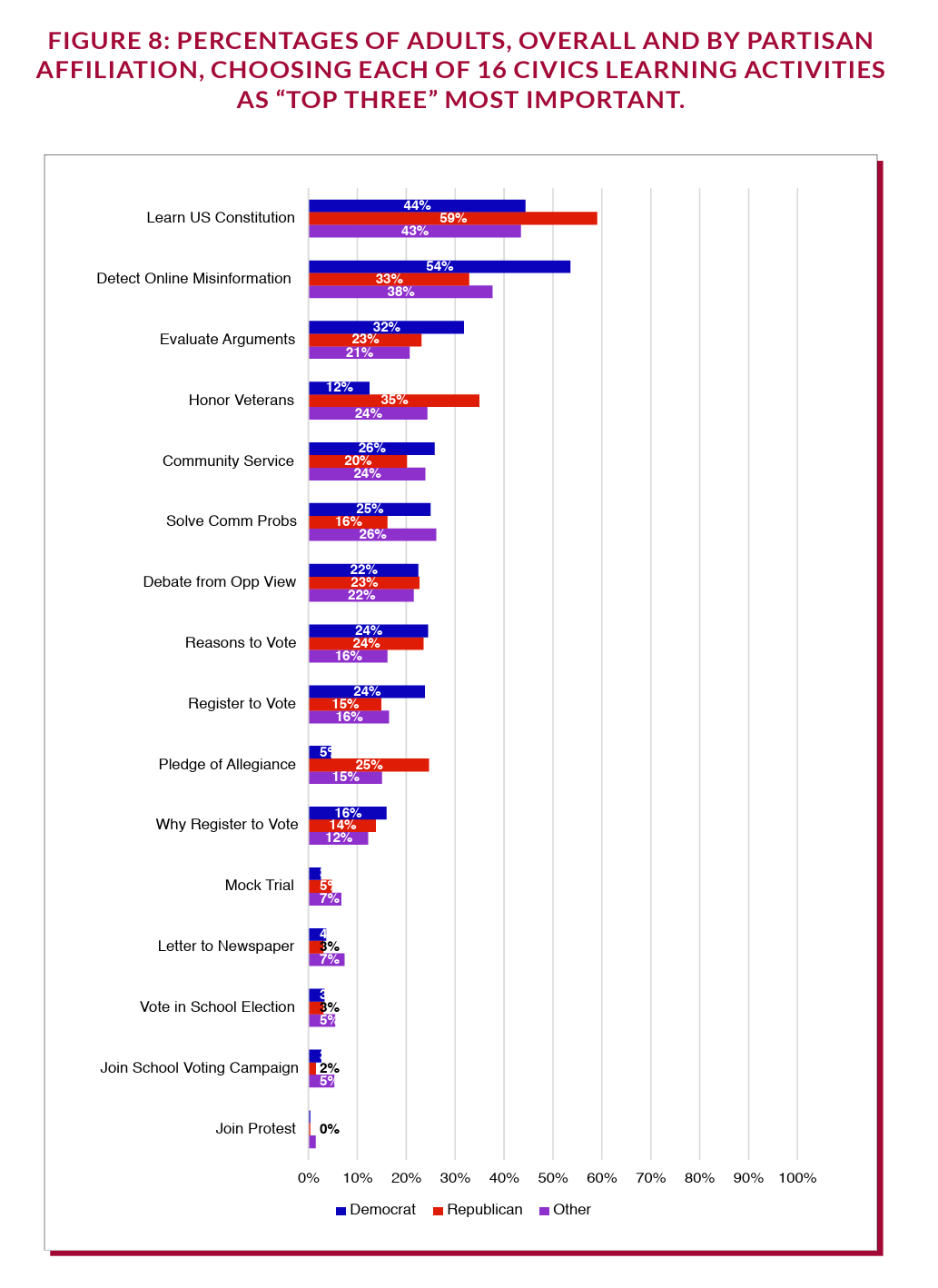
Democrats and Republicans differed on some things—Republicans were more likely to prioritize the Pledge of Allegiance and honoring veterans, which is exactly the loyalty-coded stuff Democrats have become allergic to. But both ranked learning the Constitution and detecting misinformation as their top priorities.
Put simply, people mostly agree. As Noah Smith wrote recently, “America is a nation of offline normies, ruled by online extremists.” We should center our classrooms around the things most of us actually appreciate about America—our impulse toward civil liberties, our drive for innovation, our multicultural roots—so we can finally start pointing students toward an optimistic future.
2. Implement National Service
Not military service but civil service. Perhaps a year or two after high school or college during which every American serves their country in some capacity: building infrastructure, responding to disasters, tutoring kids, caring for the elderly, restoring public lands. A civilian corps, universal and if not mandatory then at least heavily incentivized.
The idea has a long bipartisan pedigree. Kennedy foreground civic service. Clinton created AmeriCorps. George W. Bush expanded it after 9/11, calling on Americans to give two years of service in his 2002 State of the Union. On the 2020 campaign trail, Pete Buttigieg — an Afghanistan veteran — proposed scaling national service to one million positions, with new corps for climate, community health, and elder care. “I served alongside and trusted my life to people who held totally different political views,” he said. “You shouldn’t have to go to war in order to have that kind of experience.”
The logic is straightforward. Shared sacrifice creates shared identity, and right now we have almost none of the former. The only Americans with a visceral, embodied sense of serving their country are the small fraction who join the military.
For everyone else, patriotism is an abstraction and, as we’ve seen, it’s too strongly associated with the political right.
National service could change that. It would give citizens a common experience and a common vocabulary. More importantly, it could create friendships across class, race, and region: the kind of bonds that are nearly impossible to form in a country that has sorted itself so thoroughly by geography and ideology. You’d actually know the people you share a country with.
3. Recommit to Institutions
Yuval Levin, the conservative political thinker at the American Enterprise Institute, has spent years arguing that America’s crisis isn’t fundamentally about left versus right but rather the collapse of trust in our institutions.
His key insight, from A Time to Build, is that we’ve turned our institutions from molds into platforms. A mold shapes you: you enter Congress or a university or a church, and the institution forms your character and constrains your behavior. A platform showcases you: you use Congress or the university as a stage for your personal brand. The fix is a change of posture. Levin writes, “The answer is not to abandon institutions but to inhabit them more faithfully—to ask what is required of us in the roles we occupy, and then to live up to those demands.”
If that feels a little vague, then Ruy Teixeira, the political demographer behind The Liberal Patriot, adds the other half of the equation: institutions need to do something. The New Deal, the interstate highway system, the moon landing: these were all wrapped in the language of national pride and collective purpose, and they produced tangible results people could see and touch.
In Teixeira’s telling, Democrats have drifted away from a tradition of marrying patriotic language to visible, materially abundant progress, and he argues that their path back runs through an unabashedly patriotic, abundance-driven agenda—building things, making things, solving problems in ways people can see and feel.
Ezra Klein and Derek Thompson have argued the same, framing the push for stronger institutions and a “supply-side” abundance agenda as a national necessity. A country that builds big, awesome, life-improving things is a country people can get excited about. Again, this could be a bipartisan project.
But while national policy creates the framework, the actual texture of a well-lived life is local.
4. Build Local Bonds
Patrick Deneen, the Notre Dame political theorist behind Why Liberalism Failed, is probably the most controversial thinker on this list. His critique of modern liberalism is sweeping: he argues that the ideology of individual autonomy, pushed to its logical conclusion, dissolves the communal bonds that make civic life possible.
I think that’s too strong. But you don’t have to buy the whole thesis to take something useful from it. Deneen’s most practical insight, drawing on Tocqueville and Wendell Berry, is that patriotism starts locally. Not with flags or national anthems but with neighbors on your street, the school your kids attend, the town council meeting you actually show up to.
By investing time and energy in the physical spaces where you live, you’re building what Haidt would call moral capital: the norms, relationships, and habits of cooperation that make larger-scale trust possible.
So, yes, you should coach a youth sports team, organize a block party, attend a council meeting, and so on. You should show up for the unglamorous civic life happening right out your front door.
5. Create Digital Town Squares
Here’s a slightly more speculative suggestion: what if we invested—through public funding, philanthropy, or creative policy—in digital platforms designed for civic deliberation?
Imagine a local platform where your neighborhood could debate a zoning issue with real identity verification and structured turn-taking. Or a national platform where citizens from different states could discuss a proposed bill, with built-in tools for finding common ground rather than amplifying disagreement.
Tools like Decidim and Consul Democracy are already being used in cities all over the world to let residents vote on city budgets and help draft legislation.
We need a leveled-up American version of this—something with the slick UX of a world-class consumer app and the institutional backing of a major national project. The goal shouldn’t just be “functionality” but a platform that is actually a joy to use, making civic participation feel as good as flicking through Instagram.
We should treat our digital democracy with the same urgency and capital we pour into AI or defense. People would rally behind it.
CONCLUSION
Say what you want about the conservative columnist David Brooks, but he wrote a very nice final essay for the NYT Opinion section. In it, he addressed the orange elephant in the room for any discussion about a way forward for American patriotism.
He wrote:
Loss of faith produces a belief in nothing. Trump is nihilism personified, with his assumption that morality is for suckers, that life is about power, force, bullying and cruelty. Global populists seek to create a world in which only the ruthless can thrive. America is becoming the rabid wolf of nations.
Brooks is right. The president is amoral, nihilistic, and antithetical to American values. Indefensible doesn’t begin to describe it.
But Trump is also an attentional black hole, and I don’t want to pay him much mind. Time will pass; our fundamental problems will remain.
A savvier politics would focus on the good: on building a pro-America movement that people actually want to join. We need to stop merely reacting to what we hate and start investing in what we want to keep.
What Haidt discusses regarding conservatives' moral psychology being distributed more evenly across a wider range of foundations is fascinating. I think it helps explain how Trump can navigate what looks like obvious hypocrisy—running on 'America First' and 'sticking it to elites' while simultaneously pandering to them and rewarding those who reciprocate.
It also sheds light on how his Christian base squares him with their beliefs; they are often prioritizing different moral foundations than his critics are. I feel this is definitely an opportunity America can take advantage of—as both a chance and a privilege—to rebuild the institutions Trump has dismantled. He has shown us one thing for certain: you can and should 'just do things.' That kind of decisive action is exactly what a reorganization movement needs. Definitely going to check out The Righteous Mind, as always thanks for the insight Josh.