

Build, Dwell, Farm
Life sims, Heidegger, and the worlds we tend

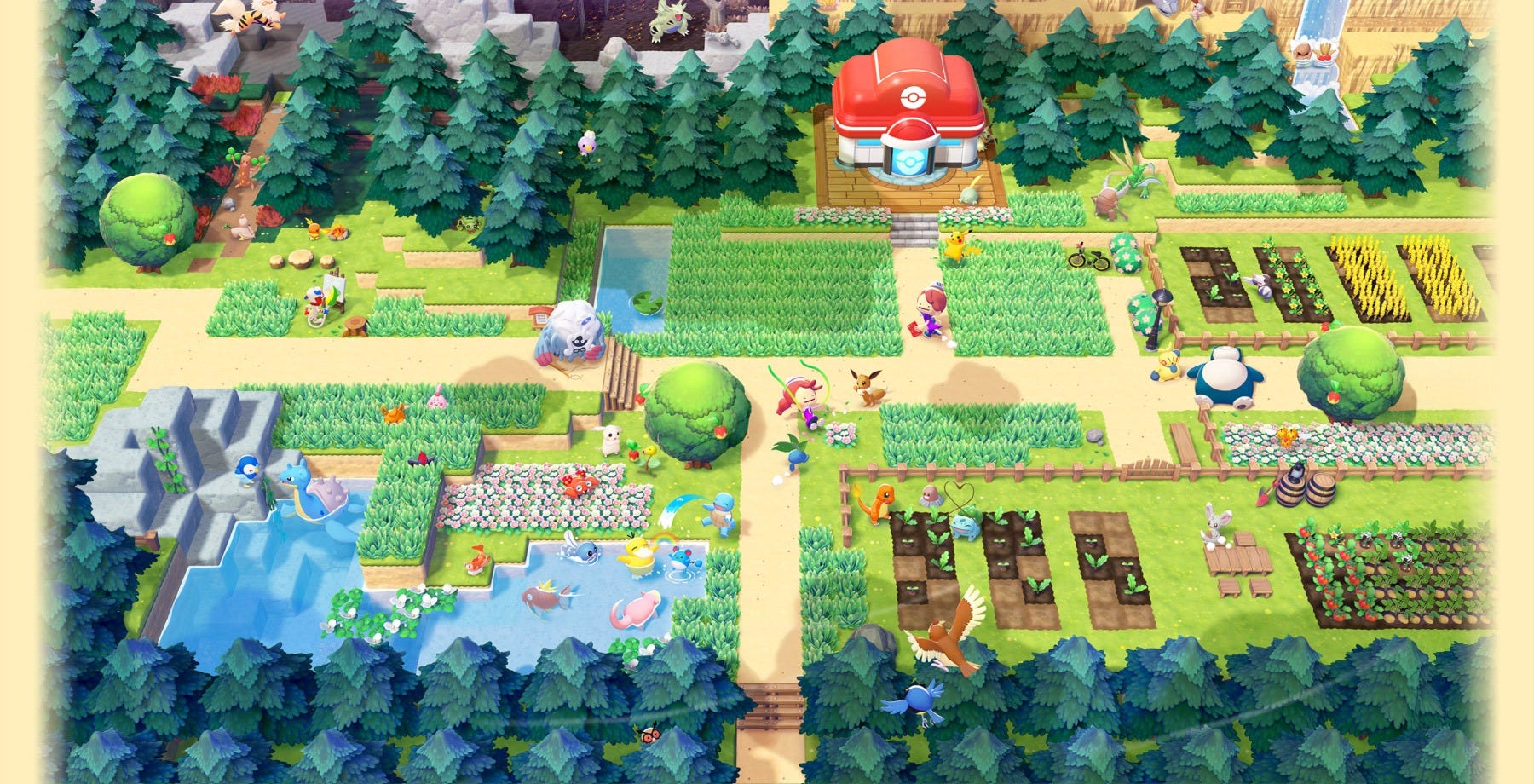
Pokopia
There’s a war in Iran, and I’m trying to convince Slowpoke to do a rain dance because Onyx told me to.
This is Pokopia, the first life simulator from The Pokémon Company, released in March 2026. You play as a shapeshifting Ditto who’s cheekily transformed itself into a human. You’ve been charged with rebuilding Poké-society in a mysterious post-apocalyptic setting.
All the (actual) humans are gone. Fortunately, there are Pokémon aplenty: a Bulbasaur who teaches you “Leafage,” allowing you to plant greenery; a Squirtle who teaches you “Water Gun,” so you can water things; a chef Pokémon who teaches you recipes. There’s no battling. Just planting, mining, watering, building, harvesting, cooking. The game sold 2.2M copies in just four days.

Ditto
Pokopia borrows liberally from other games. The life sim structure comes from Animal Crossing. The farming loop is pure Stardew Valley. The building and crafting systems are proudly descended from Minecraft. It’s a pastiche, a Ditto of a game: a greatest hits compilation of every cozy game mechanic from the last twenty-five years.
The life and farm sim genres are (quietly, calmly) booming. The top-earning game on Roblox last year was Grow a Garden, an idle farming sim that peaked at over twenty million concurrent players. Stardew Valley has sold over thirty million copies. Mobile app stores are flooded with farm and garden games—Hay Day, Township, FarmVille and its offshoots—that collectively pull tens of millions of monthly players. People keep choosing these games in ever-larger numbers.
Why?
In 1951, Martin Heidegger gave a lecture entitled “Building, Dwelling, Thinking.” Germany was in rubble and suffering through a housing crisis. The shortage of livable buildings—while a real and pressing issue—wasn’t his main concern. The bigger question was what he called “dwelling.”
Dwelling, for Heidegger, goes far deeper than merely living in a house. It’s fundamental to how humans exist in the world: by settling into a place, taking care of it, and letting that care shape who we are. “The real dwelling plight,” Heidegger says, “lies in this, that mortals ever search anew for the nature of dwelling, that they must ever learn to dwell.” In other words, humanity—technological creatures that we are—has to keep relearning what it means to belong somewhere. Seventy-five years later, millions of people are doing exactly that: inside of video games.
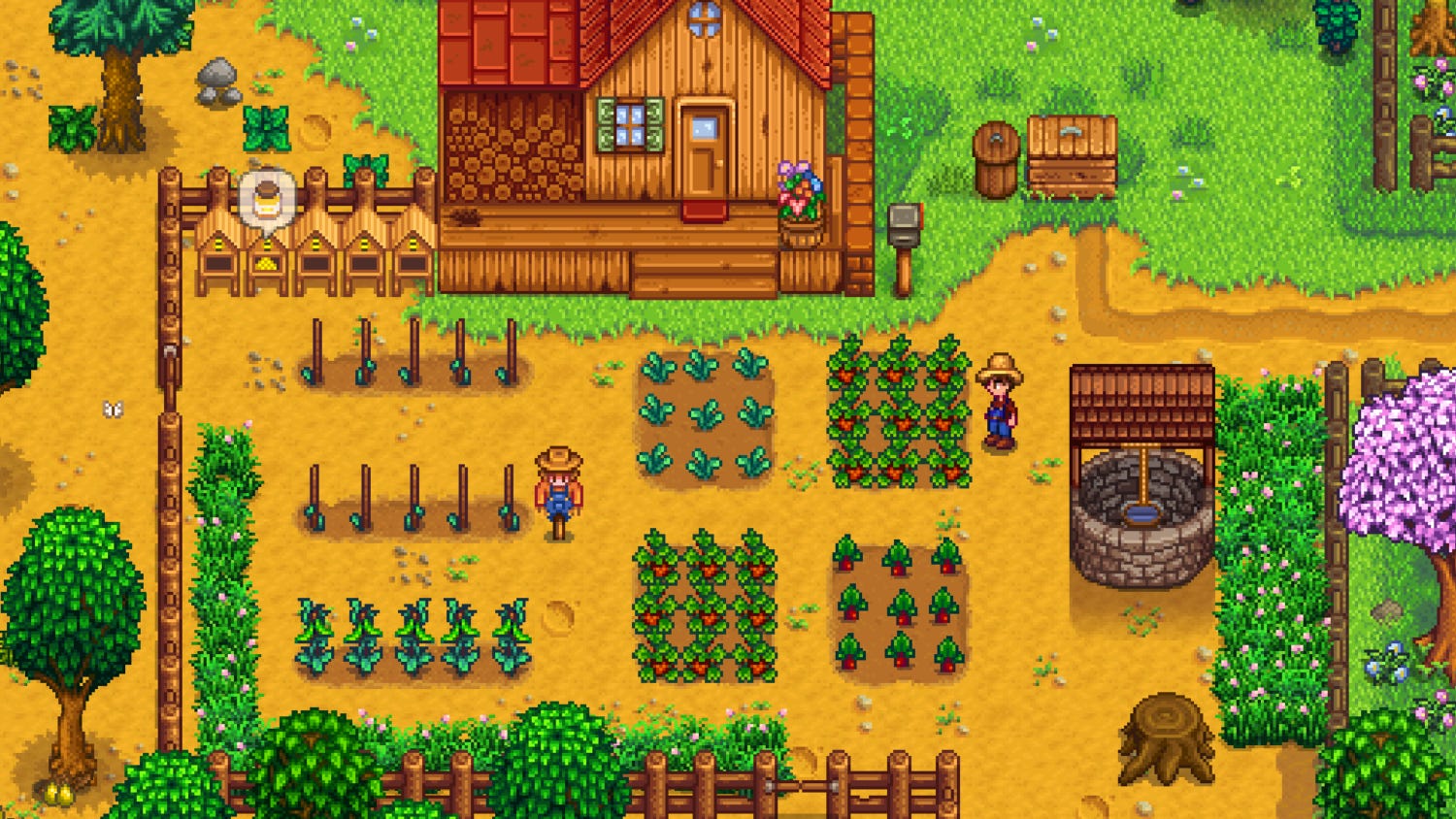
Stardew Valley
Make no mistake: Heidegger would’ve probably hated “digital dwelling.” He was deeply suspicious of any technologically mediated relationship to the world, arguing that modern technology reduces everything to a resource to be optimized. The rivers and farms of Stardew Valley are false simulacra, giving the appearance of dwelling but without the substance.
But let’s be real here (pun intended): we can’t all live in the Black Forest, taking long walks and tending gardens and reading poetry. The appeal of these games lies exactly in the dwelling urge that Heidegger identified, even if he was overly prescriptive about where and how we’re allowed to do it.
In today’s Quest, we’ll explore one of the deepest satisfactions in gaming right now: building—and dwelling within—artificial worlds.
Digital Dwelling
If you’ve played Minecraft or Stardew Valley or Pokopia, then you know the pleasure of fumbling your way through the game, up the learning curve, and gradually learning to build orderly houses, cleanly-rowed farms, elaborate watering systems.
In his lecture, Heidegger describes a Black Forest farmhouse:
Let us think for a while of a farmhouse in the Black Forest, which was built some two hundred years ago by the dwelling of peasants. Here the self-sufficiency of the power to let earth and heaven, divinities and mortals enter in simple oneness into things, ordered the house. It placed the farm on the wind-sheltered mountain slope looking south, among the meadows close to the spring. It gave it the wide overhanging shingle roof whose proper slope bears up under the burden of snow, and which, reaching deep down, shields the chambers against the storms of the long winter nights.
It’s no accident that our impulse to build just-so structures—to wrap our working minds around places that will sustain us—is now manifest in gamified spaces. We adapt to our circumstances. The neuroscientist Anil Seth has argued that all perception is a kind of controlled hallucination. We are always hallucinating reality: the brain constructs a world, moment to moment, that’s stable enough to live in.
For most of human history, the physical world was our primary “hallucination,” though we’ve always been prone to tweaking our mundane experience with stimulants, narcotics, hallucinogenic concoctions.
Eventually, we invented new hallucinations. Books let us inhabit someone else’s interiority. Movies are a dreamspace we occupy for two hours. Television series give us worlds to dwell in by proxy and at length—the comforting routines of The West Wing or The Office, the violent sublimity of Game of Thrones or Squid Game. Social media may be the most powerful hallucination yet: an incredibly addictive focalizing of our attention on one meme after another, entertainment without end.
But games do something none of these other forms can: they let us build playable hallucinations and then stay inside them. They tap into our desire not to merely witness a world but to tend one, to reach out and change it.
Pokopia understands this well. It never forces you to do anything. The game operates by the power of suggestion: there are no quests, only requests from various Pokémon, some more important than others but none mandatory. You are a Ditto, a creature of formless potential in a world without humans, and yet you’ve chosen to become a person who stays in one place and grows vegetables. (Sidenote: Aren’t we all a little like Ditto? Amorphous, imitative, copying the people around us until we find a shape that sticks?)
This is all very Heideggerian in ways well beyond me. But the basic intuition is simple enough: real dwelling has become structurally unavailable for a lot of people. Young people can’t afford to buy a house. Millions work what David Graeber called “bullshit jobs.” Most of us live in spaces we didn’t build, made of materials we can’t name, surrounded by plants and trees we’ve never identified. The farm sim inverts all of that. You place every wall and plant every crop. You know what you made and how you made it.
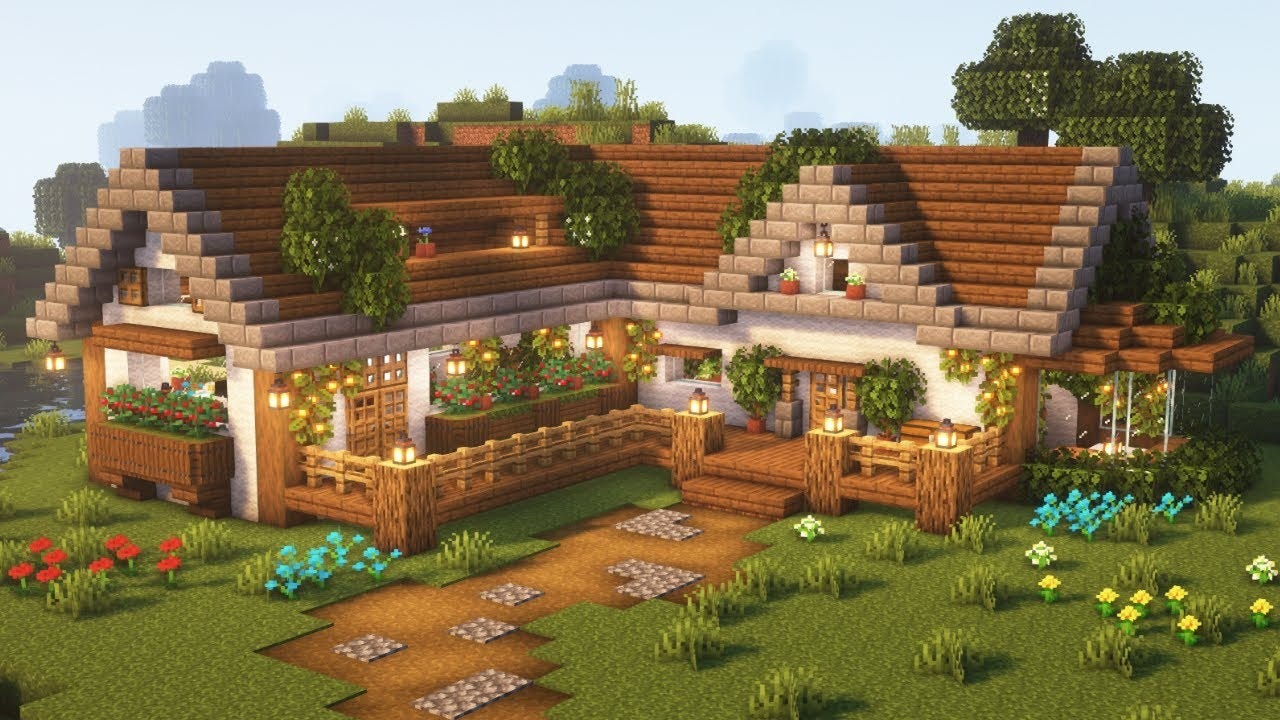
A cozy farmhouse in Minecraft
Life and farm simulators—digital dwellings—give you some experience of tending a self-created world. Some semblance of control. They are fun—sort of? occasionally?—but, more so, they’re satisfying and for a deeper reason: for that general vibe of dwelling and doing that is obviously, indisputably being lost in the real world.
Pokopia is a propulsive experience, the gaming equivalent of popping an Adderall and cleaning the house. I’ll tell myself, “I’m just going to check on my crops.” I water the vegetables. I clear out a patch of nearby dirt. Charmander waddles over and tells me he wants a house. Okay, let me get the materials. I build the hut. He likes it. What’s that over there? A bush shaking in the distance. A new Pokémon to discover…
I’ve done nothing of real consequence, but minutes pass by—then hours—and I feel prettyyy, prettyyy good. This is the loop: you act, the world responds, Pokémon show up, and you act again.

Now, there’s a cynical read to all this: the world is on fire, the economy is illegible, the culture is incoherent, the information environment is poisonous, and grown men like myself are retreating into digital gardens where problems are small and solutions are visible.
Technically true, sure, but it misses the point. We are dwelling creatures, and we weren’t built for a twenty-first century in which most of our physical needs are ostensibly met—food, shelter, water—but our psychological need to build something (anything!) is profoundly underserved.
Games don’t replace the real thing—I’m not saying people shouldn’t plant real, actual gardens because of course they should—but simulators give you the shape of it, some rhythm of care and cultivation and visible result, even if it’s with (demanding, ungrateful) Charmanders and (cute, appreciative) Pikachus running around.
The world outside is loud and large and mostly beyond my control. The worlds inside games are small and quiet and respond to my care. As AI automates more of the economy and free time expands, people are going to spend more of it in places like Pokopia. The gap between real and artificial worlds will narrow in ways we can’t fully predict yet.
Towards More Local Dwelling
It’s easy to despair in the knowledge that our most profound experiences of stewardship are happening inside of fake worlds. I get it. But I think there are more optimistic versions of digital dwelling we can imagine.
I live in the Lowcountry in South Carolina. There is an absurd abundance of life outside my door: palmettos, live oaks, marsh grass, oyster beds, alligators, egrets, fiddler crabs. Certain citrus grows well here. Apples don’t. There are specific grasses, specific soils, specific animals you can hunt and fish. I know maybe ten percent of it. I’ve lived here a few years now, and I still can’t name most of the trees on my street.

A Lowcountry marsh
Now imagine a version of Pokopia—or Stardew Valley or Minecraft or a new game entirely—that lets me load up a Lowcountry instance, a simulation built from real ecological data: my actual climate, my actual soil composition, my actual native species.
I clear a patch of virtual ground and what grows there is what would actually grow in my backyard. I learn the plants and the pests. I learn what’s indigenous and what’s invasive. I learn the hunting spots, the fishing spots, the best places to grow crops.
You get the idea. I learn about my actual world by building, playing, and dwelling within a digital version of it.
With AI and real-world geographic data, I don’t think this is a fantasy. I’d bet it’s technically feasible right now. And it flips the “digital dwelling is fake” argument on its head. Instead of pulling you away from the physical world, the game becomes a training ground for it.
The fear about digital worlds (and art forms in general, going back to Plato) has always been that they’re substitutes: pale imitations that keep us from engaging with the real thing. But maybe they don’t have to be.
Heidegger said we have to keep relearning how to dwell. I think we have much to learn yet. It’s going to get weird for sure—but perhaps not worse.
In the meantime, I’m tending a garden I can’t touch, Pokémon at my side, traipsing through somewhere that isn’t anywhere at all and feeling—against all reason—at home.

Thanks for reading! If you enjoyed this post, please leave a like below and let me know in the comments where—and how—you do most of your “dwelling.”
I think the “big quiz” from kevin kellys newsletter last week would be a fantastic Prototype for said “learn about the tactical from the technological lens” game!
https://kevinkelly.substack.com/p/the-big-here-quiz?r=ggusw&utm_medium=ios